
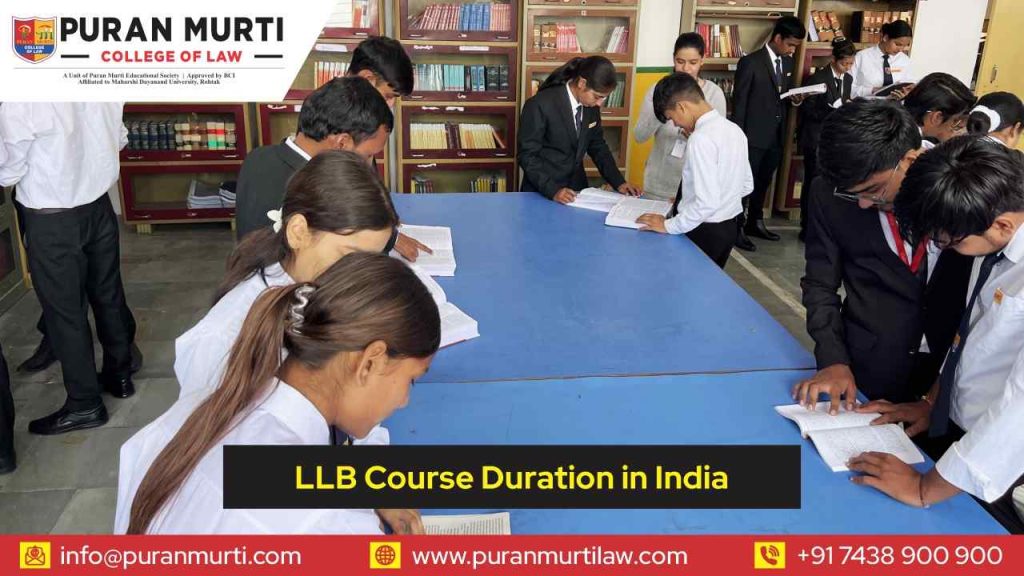
LLB Course Duration in India
Posted on : 21 August, 2026 4:53 pm
If you are planning to build a career in law, one of the first questions you may have is “What is the LLB course duration in India?” The answer depends on your current educational qualification. Students who have completed graduation can generally pursue a 3-year LLB, while students who want to study law directly after Class 12 can choose a 5-year integrated law programme such as BA LLB.
Understanding the LLB course duration in India can help students choose the right course according to their academic background and career goals. Puran Murti College of Law, for example, lists a 3-year LLB (Hons.) programme for graduates and five-year integrated law programmes for students entering after Class 12. Apply Now
What Is an LLB Course?
LLB stands for Bachelor of Laws. It is a professional law degree that helps students develop knowledge of legal principles, legislation, legal procedures and practical legal skills. The Bar Council of India’s legal education framework recognises two main undergraduate law pathways: a three-year law degree after graduation and a five-year integrated law degree after Class 12. Apply Now
| LLB Programme | Eligibility | Duration |
|---|---|---|
| 3-Year LLB | Graduation in any discipline, subject to applicable rules | 3 years |
| 5-Year Integrated LLB | Class 12 or equivalent | 5 years |
LLB Course Duration in India
The LLB course duration in India generally depends on whether you enter law after graduation or immediately after Class 12.
Three-Year LLB Course
- The 3-year LLB is designed for students who have already completed a bachelor’s degree.
For example, a student who has completed BA, BCom, BSc, BBA, BTech or another recognised graduation programme can explore admission to a three-year LLB, subject to the eligibility requirements of the institution.
- The programme generally consists of six semesters.
Puran Murti College of Law lists its LLB (Hons.) as a three-year course with graduation in any stream as the eligibility requirement. Apply Now
| Particular | 3-Year LLB |
|---|---|
| Duration | 3 years |
| Semesters | 6 |
| Entry qualification | Graduation |
| Stream in graduation | Generally any discipline |
| Course type | Professional law degree |
| Suitable for | Graduates interested in law |
Five-Year Integrated LLB
Students who have completed Class 12 do not generally enter the standalone three-year LLB. Instead, they can choose a five-year integrated law programme.
Popular options include: Apply Now
- BA LLB
- BBA LLB
- BCom LLB
- BSc LLB, where offered
The five-year programme combines an undergraduate degree with legal education and is generally divided into 10 semesters. The BCI framework specifies that integrated law programmes should be of at least five years’ duration.
| Particular | 5-Year Integrated LLB |
|---|---|
| Duration | 5 years |
| Semesters | 10 |
| Entry qualification | Class 12 |
| Popular course | BA LLB |
| Suitable for | Students after Class 12 |
3-Year LLB vs 5-Year Integrated LLB
Students often get confused between these two programmes. The biggest difference is the qualification required before admission.
| Feature | 3-Year LLB | 5-Year Integrated LLB |
|---|---|---|
| Entry point | After graduation | After Class 12 |
| Duration | 3 years | 5 years |
| Semesters | 6 | 10 |
| Degree structure | Standalone LLB | Bachelor’s + LLB |
| Suitable for | Graduates | Class 12 students |
| Example | LLB (Hons.) | BA LLB / BBA LLB |
| Higher studies | LLM, etc. | LLM, etc. |
- The BCI’s Rules of Legal Education distinguish the three-year law degree from the five-year integrated degree programme. Apply Now
LLB Course Duration at Puran Murti College of Law
Students researching LLB colleges in Haryana can consider Puran Murti College of Law as one of the options.
- According to its published course information, Puran Murti College of Law offers LLB (Hons.) as a three-year programme. The eligibility listed is graduation in any stream, and the course is divided semester-wise.
The college also lists integrated law options for students entering after Class 12. Its published course information describes five-year integrated programmes such as BA LLB.
| Course at Puran Murti | Duration | Entry Level |
|---|---|---|
| LLB (Hons.) | 3 years | After graduation |
| BA LLB | 5 years | After Class 12 |
Students should verify the latest affiliation, recognition, eligibility, fees and admission rules directly with the college before applying. Apply Now

LLB Eligibility According to Course Duration
Your educational qualification determines which LLB route you can choose.
Eligibility for 3-Year LLB
Generally, students need to:
- Complete a recognised bachelor’s degree.
- Meet the minimum marks prescribed by the university or college.
- Fulfil other institutional admission requirements.
The BCI framework describes the three-year law degree as a programme undertaken after obtaining a bachelor’s degree in any discipline. Apply Now
Eligibility for 5-Year Integrated LLB
Students generally need to:
- Complete Class 12 or an equivalent qualification.
- Meet the minimum percentage prescribed by the institution.
- Fulfil any entrance examination or admission requirements applicable to the college.
The BCI framework allows candidates who have completed senior secondary education or an equivalent qualification to enter an integrated law programme. Apply Now
LLB Course Duration and Semester Structure
The academic structure may vary between universities, but the usual structure looks like this:
3-Year LLB
| Year | Semesters |
|---|---|
| First Year | Semester 1 & 2 |
| Second Year | Semester 3 & 4 |
| Third Year | Semester 5 & 6 |
5-Year Integrated LLB
| Year | Semesters |
|---|---|
| First Year | Semester 1 & 2 |
| Second Year | Semester 3 & 4 |
| Third Year | Semester 5 & 6 |
| Fourth Year | Semester 7 & 8 |
| Fifth Year | Semester 9 & 10 |
What Do Students Study During LLB?
An LLB programme covers different areas of law and develops both theoretical and practical understanding.
Common subjects include:
- Constitutional Law
- Criminal Law
- Contract Law
- Family Law
- Property Law
- Administrative Law
- Company Law
- Labour Law
- Environmental Law
- Cyber Law
- Intellectual Property Rights
- Evidence Law
- Civil Procedure
- Legal Research
- Professional Ethics
Is Practical Training Important During LLB?
Yes. Law is a professional field, so students should not focus only on classroom learning.
| Activity | Skills Developed |
|---|---|
| Moot Courts | Legal arguments and advocacy |
| Internships | Professional exposure |
| Legal Research | Research and analysis |
| Legal Drafting | Professional writing |
| Legal Aid | Understanding access to justice |
| Seminars | Communication and presentation |
| Court Visits | Understanding legal proceedings |
Puran Murti College of Law’s published information highlights practical legal education, including moot court activities and internships. Apply Now
Is LLB a Full-Time Course?
Students should carefully check the mode of study before admission. The Ministry of Law and Justice stated in February 2026 that under the applicable BCI framework, the LLB is a regular, full-time professional course with prescribed classroom hours and attendance requirements.
- Therefore, students who want to pursue an LLB should verify that the programme meets the applicable legal education requirements. Apply Now
Can You Become a Lawyer After LLB?
An LLB is the academic qualification required for the professional pathway into legal practice, but completing the degree is not the only step. Students intending to practise as advocates must meet the applicable professional requirements, including requirements concerning enrolment and the All India Bar Examination.
The Bar Council of India’s AIBE notification confirms that candidates who have completed three-year or five-year LLB programmes from BCI-recognised universities or BCI-approved colleges affiliated with recognised universities can fall within the relevant eligibility framework. Apply Now
Career Options After LLB
After completing an LLB, students can explore different career paths. Apply Now
| Career Option | Work Area |
|---|---|
| Advocate | Litigation and legal representation |
| Corporate Lawyer | Corporate and business law |
| Legal Advisor | Legal guidance |
| Legal Consultant | Professional legal consultancy |
| Legal Researcher | Research and case analysis |
| Compliance Professional | Regulatory compliance |
| Legal Writer | Legal content and documentation |
| Government Legal Roles | Public-sector legal work |
| Judiciary Aspirant | Preparation for judicial services |
Why Choose Puran Murti College of Law?
Students looking for a law college in Haryana can include Puran Murti College of Law in their comparison.
- Three-year LLB (Hons.) programme
- Graduation-based eligibility
- Semester-wise course structure
- Legal research skills
- Analytical and critical thinking
- Moot court and practical exposure
- Internship opportunities
- Higher education opportunities such as LLM and PhD
How to Choose the Right LLB College?
Knowing the LLB course duration in India is only the beginning. Choosing the right college is equally important.
| Factor | What to Check |
|---|---|
| Recognition | Applicable BCI approval/recognition |
| Affiliation | University awarding the degree |
| Faculty | Qualifications and experience |
| Curriculum | Academic + practical subjects |
| Internships | Availability of practical exposure |
| Moot Court | Training and competitions |
| Library | Legal books and digital resources |
| Fees | Complete cost of education |
| Location | Accessibility and accommodation |
| Career Support | Guidance and professional opportunities |
FAQs
How many years is an LLB course in India?
A standalone LLB after graduation generally takes 3 years, while an integrated law programme after Class 12 generally takes 5 years.
Can I do LLB after Class 12?
You generally cannot enter the standalone three-year LLB directly after Class 12. Instead, you can choose a five-year integrated programme such as BA LLB. Apply Now
Can I do a 3-year LLB after graduation?
Yes. Graduates can apply for three-year LLB programmes if they meet the eligibility requirements of the concerned university or college.
How many semesters are there in a 3-year LLB?
A three-year LLB generally consists of six semesters. Puran Murti College of Law lists its LLB (Hons.) as a three-year programme.
How many semesters are there in a 5-year integrated LLB?
A five-year integrated programme generally consists of 10 semesters.
Is LLB a full-time course?
Under the applicable BCI framework, LLB is a regular, full-time professional course.
What is the difference between LLB and BA LLB?
LLB is a standalone law degree generally pursued after graduation, while BA LLB combines a bachelor’s degree in arts with legal education and is generally pursued directly after Class 12. Apply Now
Can I pursue LLM after LLB?
Yes. Students who complete a recognised LLB can explore LLM programmes, subject to the eligibility criteria of the selected institution.
Conclusion
Understanding the LLB course duration in India helps students choose the correct pathway according to their current qualification. If you have already completed graduation, a 3-year LLB is the standard route to explore. If you have completed Class 12 and want to enter law directly, a 5-year integrated programme such as BA LLB is generally the appropriate option. Apply Now
Puran Murti College of Law is one institution students can consider while exploring law education in Haryana. Its published information lists a 3-year LLB (Hons.) programme for graduates as well as integrated law options for students after Class 12.