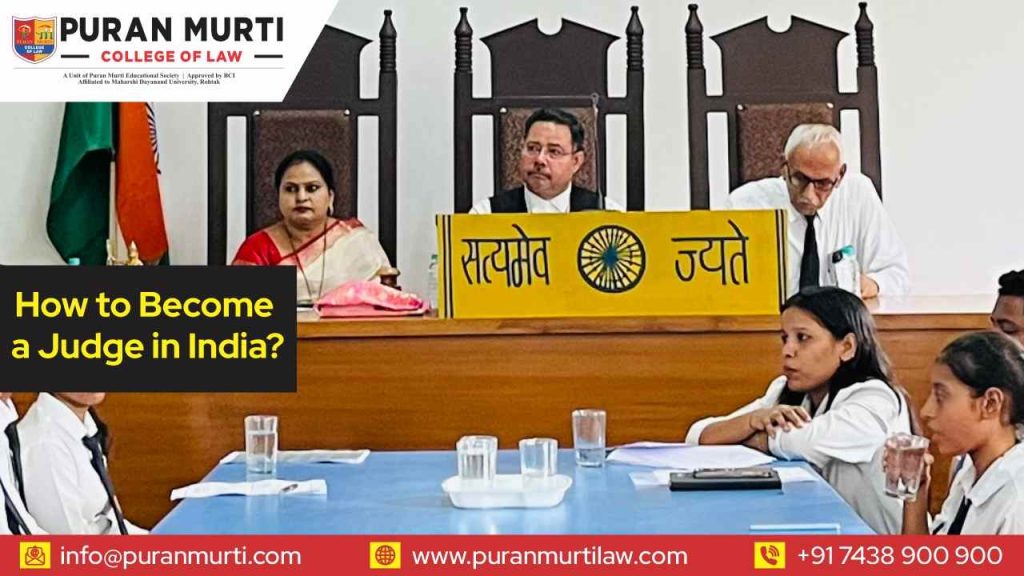
How to Become a Judge in India?
Posted on : 5 September, 2026 12:15 pm
Becoming a judge in India is a respected career option for students who are interested in law, justice, reasoning, and public service. Moreover, the judicial profession offers an opportunity to interpret laws, hear cases, evaluate evidence, and deliver judgments.
If you are wondering How To Become A Judge In India, the first step is to understand the educational qualification, judicial service examination, selection process, and career progression. However, the exact eligibility conditions, age limits, practice requirements, syllabus, and recruitment procedure can vary between states.
In 2026, recruitment to the lower judiciary continues to be governed through rules framed by the respective State Governments in consultation with the concerned High Courts.
“A career in the judiciary requires legal knowledge, patience, logical reasoning, integrity, and a strong commitment to justice.”
Who Is A Judge?
A judge is a judicial officer responsible for hearing cases, examining evidence, interpreting applicable laws, and making decisions according to the law.
Judges work at different levels of the Indian judicial system. These include subordinate or district courts, High Courts, and the Supreme Court.
Therefore, the route to becoming a judge depends on the level of judiciary a candidate wants to enter.
How To Become A Judge In India After 12th?
Students who want to become judges can begin their journey after Class 12.
A common route is to pursue a 5-year integrated law degree, such as:
- BA LLB
- BBA LLB
- BCom LLB
- BSc LLB
The five-year integrated law programme combines undergraduate education with legal studies. As a result, students can complete their law degree directly after Class 12.
Another route is to complete a bachelor’s degree in any eligible discipline and then pursue a 3-year LLB.
Importantly, the law degree should be from an institution recognised or approved as required under the applicable legal-education framework. The Bar Council of India’s current AIBE information, for example, recognises eligibility for graduates of BCI-recognised universities or approved colleges.
Error: Contact form not found.
How To Become A Judge After LLB?
After completing an LLB, candidates can explore the State Judicial Service Examination route for entry into the lower judiciary, subject to the rules of the particular state.
The process generally involves:
- Completing an eligible law degree
- Meeting the applicable eligibility conditions
- Applying for the state judicial service examination
- Preparing for the examination
- Clearing the preliminary examination, where applicable
- Clearing the mains examination
- Appearing for the interview or viva voce, where applicable
- Completing document verification and other formalities
- Completing judicial training after appointment, as prescribed
However, candidates should always check the latest notification issued by the concerned High Court, State Public Service Commission, or other recruiting authority.
Eligibility To Become A Judge In India
Eligibility requirements are not completely uniform across India.
The Department of Justice has clarified that the respective State Governments, in consultation with the High Courts, frame the rules and regulations for recruitment and appointment of judicial officers in the lower judiciary.
Therefore, candidates should check the rules applicable to the state where they intend to apply.
Educational Qualification
Generally, candidates need a recognised law degree such as an LLB or an integrated law degree.
For example, candidates may complete:
- 5-year BA LLB after Class 12
- 5-year BBA LLB after Class 12
- 3-year LLB after graduation
Age Limit
The minimum and maximum age requirements depend on the particular judicial service recruitment notification.
Therefore, candidates should not assume that the same age limit applies in every state.
Legal Practice Requirement
This is an important area to check carefully because eligibility rules have been changing and may differ by recruitment cycle.
The Department of Justice stated in a March 2026 Lok Sabha answer that the rules for lower judiciary recruitment are framed by individual states in consultation with their High Courts.
Consequently, candidates should rely on the latest official recruitment notification rather than an old eligibility guide.
Judicial Service Examination In India
The judicial service examination is the major recruitment route for entry-level judicial officers in many states.
The examination structure may differ from one state to another. However, it commonly involves multiple stages.
Preliminary Examination
The preliminary examination is generally an objective-type screening examination.
Depending on the state, subjects may include:
- Constitutional Law
- Indian Penal Code/Bharatiya Nyaya Sanhita-related criminal law
- Criminal Procedure
- Civil Procedure
- Evidence Law
- Contract Law
- Property Law
- Family Law
- Local Laws
- General Knowledge
- Current Affairs
- English
- Language papers
The exact syllabus should always be checked against the latest notification.
Mains Examination
Candidates who qualify for the preliminary stage may appear for the mains examination.
The mains examination generally tests deeper legal knowledge and writing ability. Moreover, candidates may need to answer descriptive questions involving legal principles, problem questions, essays, language papers, and other state-specific subjects.
Interview
Candidates who qualify for the written stages may be called for an interview or viva voce, depending on the recruitment rules.
The interview may assess:
- Legal understanding
- General awareness
- Communication
- Reasoning ability
- Personality
- Confidence
- Awareness of current affairs
Therefore, preparation should not be limited to memorising legal provisions.
How To Prepare For Judicial Service Examination?
Judicial service examinations require consistent preparation. Instead of studying only before the examination, candidates should follow a structured routine.
1. Understand The Syllabus
First, download and carefully read the latest syllabus and examination notification.
Make a list of every subject and divide the syllabus into manageable sections.
2. Study Bare Acts
Bare Acts are particularly important for judicial service preparation.
Students should develop a clear understanding of legal provisions rather than relying entirely on summaries.
3. Practise Previous Papers
Previous-year question papers help candidates understand the examination pattern and frequently tested areas.
Moreover, solving papers under time limits can improve speed and accuracy.
4. Improve Answer Writing
Answer writing is especially important for descriptive examinations.
Candidates should practise:
- Legal reasoning
- Case analysis
- Problem questions
- Judgments
- Essays
- Legal language
- Structured answers
5. Follow Current Affairs
A judge needs awareness beyond textbooks. Therefore, candidates should regularly follow important legal and national developments.

Skills Required To Become A Judge
Academic knowledge is important. However, judicial officers also require several professional qualities.
Legal Knowledge
A strong understanding of substantive and procedural law is essential.
Logical Reasoning
Judges need to examine facts and apply the relevant law logically.
Decision-Making
Judicial work involves analysing arguments and reaching legally sound conclusions.
Communication
Clear writing and effective communication are important for judicial work.
Patience
Judicial proceedings can involve lengthy arguments and complex facts. Therefore, patience and concentration are valuable qualities.
Integrity
Judicial officers are expected to maintain impartiality, independence, and professional ethics.
Career Path Of A Judge In India
The judicial career can provide opportunities for progression over time.
A simplified career path can look like:
Judicial Service → Civil Judge → Senior Civil Judge → Higher Judicial Positions → District Judge
The exact designations and promotion structure vary between states.
The Department of Justice explains that district judge entry-level vacancies can be filled through direct recruitment as well as promotion routes. Its current information describes a framework involving direct recruitment and promotion within the subordinate judiciary.
Therefore, becoming a judge through judicial service can provide a structured long-term career.
How To Become A District Judge In India?
There are different routes to becoming a District Judge.
One route involves progressing through the judicial service and receiving promotions according to applicable service rules.
Another route can involve direct recruitment to the District Judge entry level, subject to the eligibility requirements and recruitment process prescribed by the concerned state.
The Department of Justice currently notes that District Judge entry-level recruitment includes a direct-recruitment component as well as promotion routes.
However, candidates should check the latest state-specific notification before applying.
How To Become A High Court Judge?
Becoming a High Court judge is different from entering the lower judiciary through a state judicial service examination.
High Court appointments are made under the constitutional framework, particularly Articles 217 and 224.
Therefore, completing an LLB alone does not mean that a person can directly apply for a High Court judgeship through a regular competitive examination.
The career generally involves substantial legal or judicial experience and follows the constitutional appointment process.
Error: Contact form not found.
How To Become A Supreme Court Judge?
The Supreme Court is the highest court in India.
Appointments to the Supreme Court are governed by Article 124 of the Constitution of India.
Therefore, the route is different from the state judicial service examination used for entry into the lower judiciary.
Candidates interested in reaching the Supreme Court should understand that it is generally a long-term career progression involving extensive judicial or legal experience.
Is BA LLB Good For Becoming A Judge?
Yes, BA LLB can be a suitable law degree for students who want to pursue the judiciary.
The five-year integrated programme allows students to begin legal education after Class 12. Moreover, subjects such as political science, economics, sociology, history, constitutional law, and other legal subjects can provide a broad academic foundation.
Students can also use their college years to participate in:
- Moot courts
- Legal research
- Internships
- Legal writing
- Debates
- Case analysis
For example, students pursuing BA LLB (Hons.) at a recognised institution can start preparing for judicial service examinations alongside their academic studies.
Can A Final-Year Law Student Become A Judge?
A candidate’s eligibility depends on the recruitment notification applicable to the particular state and examination cycle.
Some recruitment rules may allow final-year candidates subject to conditions, while others may require the law degree to have been completed by a specified date.
Therefore, students should always read the latest official notification before submitting an application.
Judge Salary In India
The salary of a judge depends on the judicial level, state, pay structure, allowances, and applicable service rules.
For example, the Rajasthan High Court published a 2026 order showing a Senior Civil Judge Cadre pay scale of ₹1,22,700–₹1,80,200 at Pay Level J-4 under the applicable career progression framework.
However, this should not be treated as a uniform salary for every judge in India.
Therefore, candidates should check the relevant state’s latest recruitment notification and service rules for accurate salary information.
Judge Vs Lawyer: What Is The Difference?
| Factor | Judge | Lawyer |
|---|---|---|
| Main Role | Decides cases according to law | Represents and advises clients |
| Work | Hears cases and passes orders/judgments | Prepares arguments and represents parties |
| Career Route | Judicial recruitment/constitutional appointment | Law degree + applicable professional requirements |
| Workplace | Courts | Courts, law firms, companies, chambers, organisations |
| Key Skills | Impartiality, reasoning, decision-making | Advocacy, drafting, negotiation, research |
Both careers require strong legal knowledge. However, their responsibilities are different.
Common Mistakes To Avoid During Judicial Preparation
Students preparing for judicial service examinations should avoid several common mistakes.
First, do not depend only on coaching notes. Bare Acts and reliable legal resources are also important.
Second, do not ignore answer writing. Knowledge must be converted into clear and legally structured answers.
Third, do not prepare without checking the state-specific syllabus.
Furthermore, avoid relying on outdated eligibility information. Judicial recruitment rules can change, so the latest official notification should always be treated as the primary source.
Is Becoming A Judge Difficult?
Becoming a judge can be challenging because judicial service examinations are competitive and require strong preparation.
However, with a proper strategy, consistent study, revision, mock tests, and answer-writing practice, candidates can improve their chances.
The key is to start early and maintain consistency.
Why Choose Judiciary As A Career?
Judiciary can be an attractive career for students who want to work in the justice system.
Some potential advantages include:
- Respectable professional position
- Structured career progression
- Opportunity to serve society
- Intellectual challenges
- Legal decision-making responsibilities
- Long-term professional development
- Exposure to different areas of law
However, the profession also demands discipline, impartiality, responsibility, and continuous learning.
Conclusion
If you are wondering How To Become A Judge In India, the journey generally begins with obtaining an eligible law degree and then meeting the recruitment requirements of the judicial service or the applicable constitutional appointment route.
For students planning to enter the lower judiciary, a five-year integrated law course such as BA LLB after Class 12 or a three-year LLB after graduation can provide the academic foundation. Moreover, candidates need to prepare seriously for the relevant judicial service examination and follow the latest state-specific rules.
However, there is no single recruitment pattern applicable to every state. The Department of Justice confirms that lower judiciary recruitment rules are framed by respective State Governments in consultation with High Courts.
Ultimately, students who combine strong legal knowledge with logical reasoning, answer-writing ability, integrity, patience, and consistent preparation can build a meaningful career in the judiciary.
Eligibility for Puran Murti Vidyapeeth Law Courses
Eligibility depends on the programme you choose.
BA LLB (Hons.) Eligibility
Generally, students need to:
- Pass Class 12 or an equivalent examination from a recognised board.
- Meet the minimum marks requirement prescribed by the university/college and applicable regulations.
- Fulfil any other admission requirements applicable for the academic session.
The institution’s published information has listed minimum marks around 45%, with applicable relaxations depending on category and norms. Students should verify the current requirement before submitting an application. Apply Now
Is Puran Murti Vidyapeeth Law Course Right for You?
Puran Murti Vidyapeeth can be considered by students looking for law education in the Sonipat/Delhi-NCR region. Its current law offerings include BA LLB (Hons.), LLB (Hons.) and LLM, giving students options at undergraduate and postgraduate levels. Apply Now
The biggest advantage is that students can choose a programme based on where they are in their academic journey:
- After Class 12 → BA LLB (Hons.)
- After graduation → LLB (Hons.)
- After LLB → LLM
-
LLB (Hons.) Eligibility
For the three-year LLB programme, applicants generally need:
- A recognised bachelor’s degree in any stream.
- The required minimum percentage under the applicable rules.
- Any additional conditions prescribed by the university or college.
The three-year LLB route is particularly suitable for graduates who decide to move into law after completing another bachelor’s degree.
LLM Eligibility
For LLM, applicants generally need a recognised:
- LLB degree, or
- BA LLB/equivalent law degree.
The specific eligibility conditions should be checked for the current admission cycle. Apply Now
Puran Murti Law Courses Admission Process
The admission process can vary depending on the programme and the rules applicable for the academic year.
A typical process includes:
- Check eligibility – Confirm your academic qualification and marks.
- Select the course – Choose BA LLB, LLB or LLM according to your educational background.
- Submit the application – Complete the required admission form.
- Provide documents – Submit academic and other required documents.
- Complete counselling/selection requirements – Follow the admission instructions provided by the institution.
- Pay applicable fees – Complete the admission formalities after selection.
- Begin the programme – Attend orientation and regular classes.
Frequently Asked Questions
1. How To Become A Judge In India after 12th?
Students can pursue a five-year integrated law degree such as BA LLB after Class 12. After completing the degree, they can check the eligibility requirements for the relevant State Judicial Service Examination.
2. Can I become a judge after BA LLB?
Yes. BA LLB can provide the required law qualification for judicial service recruitment, subject to the eligibility conditions of the relevant state.
3. Is LLB compulsory to become a judge?
For judicial positions requiring a law qualification, candidates need an eligible law degree. The exact qualification depends on the judicial post and applicable recruitment rules.
4. Is there one judicial exam for all of India?
No. Lower judiciary recruitment is generally conducted according to state-specific rules and recruitment processes. The Department of Justice confirms that State Governments, in consultation with High Courts, frame the relevant lower judiciary recruitment rules.
5. Can I become a judge directly after LLB?
It depends on the applicable state recruitment rules. Candidates must satisfy the educational, age, practice, and other requirements mentioned in the latest notification.
6. What subjects should I study for the judiciary exam?
Common areas include constitutional law, civil and criminal law, evidence, contracts, family law, local laws, language, general knowledge, and current affairs. However, the exact syllabus varies by state.
7. Is BA LLB better than 3-year LLB for judiciary?
Neither degree is universally “better.” A BA LLB allows students to study law directly after Class 12, while a three-year LLB is pursued after graduation. Both can provide a route to judicial careers where the applicable recruitment rules accept them.