
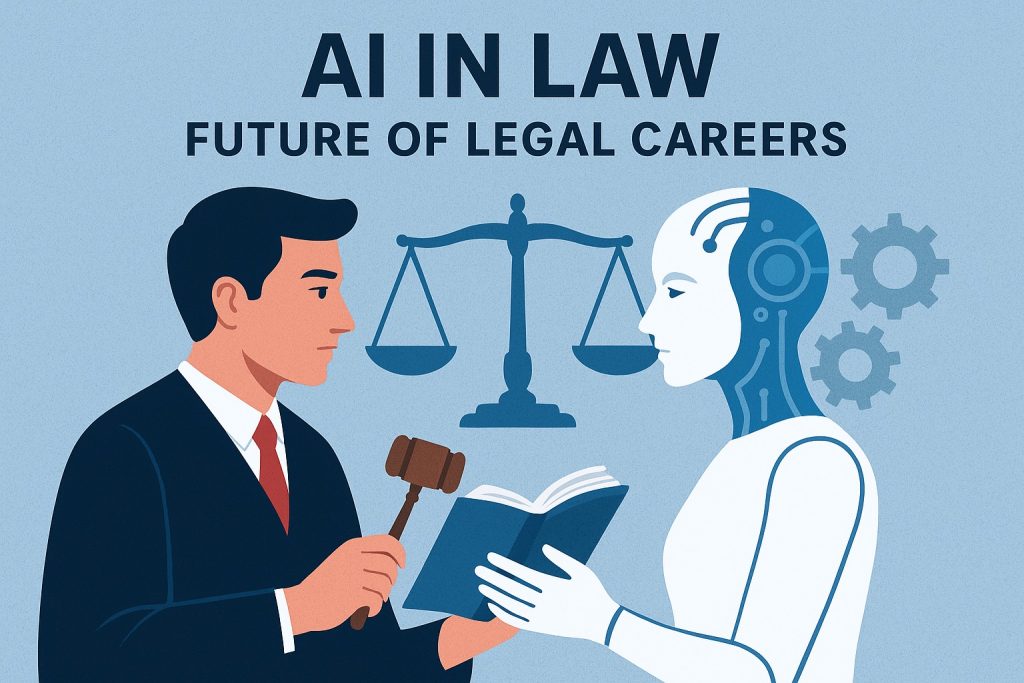
AI in Law — Opportunities & Careers
Posted on : 17 December, 2025 12:44 am
We are living in an age of rapid technological change. Artificial Intelligence (AI), machine learning, data-driven automation and digital tools are transforming many fields — including the ancient and venerable domain of law.
In India and globally, the rise of AI is reshaping how legal work is done — from research to drafting to litigation strategy, contract review, compliance, and dispute resolution. For current law students and early-career lawyers, this means: the legal profession of tomorrow will look different. It will demand tech-savvy, adaptability, and a blend of legal and digital skills. At the same time, AI opens up new career paths and opportunities that were unthinkable before.
In this blog, we’ll explore: what AI in law means today; how it changes legal careers; which legal roles are likely to grow; what you need to learn; and what challenges exist.
What Does “AI in Law” Really Mean?
When we say “AI in law,” we are referring to the use of Artificial Intelligence — algorithms, machine learning, natural language processing (NLP), data analysis — to assist or automate tasks that previously required human legal professionals. Some common AI-powered applications in law:
-
Legal research & case-law analysis: Tools that can scan thousands of past judgments, statutes, regulations and quickly identify relevant precedents, flag similarities, help build arguments.
-
Contract review & due diligence: AI can review long contracts to highlight clauses, flag risks, suggest edits, compare across versions.
-
Document automation & drafting: AI-based document-generation tools can draft standard legal documents (contracts, NDAs, affidavits), reducing time and errors.
-
Predictive analytics: Based on past data, AI can provide risk assessments, predict litigation outcomes, or analyze probability of winning cases.
-
Legal-tech platforms & compliance automation: Corporate compliance, regulatory changes, data-privacy laws — AI can help monitor, alert, and ensure firms adhere to new regulations.
-
E-discovery & evidence analysis: In large civil or corporate litigation, AI can sift through huge volumes of documents, emails, communications.
-
Client-facing chatbots & virtual assistants: AI chatbots to answer basic legal queries, schedule meetings, gather information.
-
Alternative dispute resolution (ADR) & online mediation platforms: Using AI for mediation, negotiation tools, or automated settlement suggestions.
In short: AI is helping with speed, efficiency, accuracy, and handling huge volumes of data — enabling legal professionals to focus on high-value tasks (strategy, advocacy, negotiation) rather than paperwork and repetition.
Why AI Is Reshaping Legal Careers (And Not Replacing Them Fully)
It’s tempting to fear that AI will replace lawyers — but the reality is more nuanced. Here’s why AI changes, but doesn’t eliminate, legal careers:
What AI Does Better
-
Fast processing of large data and documents.
-
Pattern recognition — spotting precedents, clauses, compliance issues.
-
Automating repetitive, time-consuming tasks.
-
Reducing human error, speeding due diligence, cutting costs, increasing access to legal services.
What Only Human Lawyers Can Do
-
Interpret complex facts, emotions, and human context.
-
Argue persuasive cases in court.
-
Apply judgment, moral values, ethics.
-
Build client relationships, negotiate, network.
-
Handle nuanced disputes requiring empathy, human sensibility.
Thus, AI becomes a tool, not a substitute. And lawyers who learn to use AI smartly — as an aid — will likely excel and evolve, rather than become obsolete.
Emerging High-Demand Legal Roles in the Age of AI
As AI changes the landscape, some legal career roles will rise in demand. Here are promising — and high-future — roles for law graduates:
| New / Evolving Role | What You Do / Skills Needed |
|---|---|
| Legal Tech Specialist / Legal-AI Consultant | Work at intersection of law and technology — help firms integrate AI solutions, manage legal-tech projects, compliance automation. |
| Data-Privacy & Cyber-Law Expert | Advise companies on data protection, privacy laws, compliance with digital regulations (cybersecurity, AI ethics, data laws). |
| Compliance & Regulatory Lawyer (Tech sector) | Help tech firms, startups comply with regulations — automate compliance tasks, regulatory audits, report generation. |
| Contract Lifecycle Manager (with AI tools) | Use AI for contract drafting, risk analysis, monitoring compliance, renewals, audits. |
| E-Discovery & Litigation Support Analyst | Manage large data/evidence via AI tools for litigation, help prepare for corporate/civil suits or criminal defense. |
| Alternative Dispute Resolution (ADR) Mediator / Online Arbitrator | Use tech-enabled platforms for mediation, negotiate settlements, use predictive tools to settle faster. |
| Legal Research Analyst (with AI advantage) | Combine traditional legal research with AI to quickly produce high-quality, in-depth legal analysis, research reports, whitepapers. |
| Policy & AI Ethics Advisor / Tech-Policy Lawyer | Help governments, think-tanks or companies draft AI-regulations, data policies, compliance frameworks. |
| In-house Counsel for Tech Firms / Startups | Work inside startups/tech firms — manage legal aspects of AI projects, IP, data security, compliance. |
These roles reflect a blend of law, technology and business awareness. For students — they represent new, future-oriented career paths beyond traditional litigation or courtroom practice.
Benefits for Lawyers Adopting AI — Why It’s Advantageous
Efficiency & Productivity
AI automates routine tasks. A lawyer who uses AI for research or contract review can handle 5–10 times more work in less time. This boosts productivity and profitability.
Better Quality & Accuracy
Less human error, consistent compliance checks, better document drafting — leads to higher quality legal services.
More Access & Affordability
With AI-driven automation, legal services become cheaper and faster. More people can afford legal representation — expanding client base and demand.
Competitive Edge & Marketability
Lawyers familiar with AI tools will be more valuable to progressive firms, corporates, cross-border clients, and global companies.
New Career Opportunities & Innovation
Legal tech startups, AI-savvy law firms, compliance departments, data-privacy departments — all need lawyers with a tech perspective.
Challenges & Ethical Concerns — What to Watch Out For
AI’s rise is not without problems. Legal professionals must be aware of the issues:
-
Data privacy & confidentiality — using AI tools means uploading sensitive client data; what if there’s breach or misuse?
-
Bias in AI algorithms — past data may contain biased judgments; AI may perpetuate injustice or partiality.
-
Reliance on automation may reduce critical thinking — overdependence can weaken lawyer’s reasoning and judgment skills.
-
Regulatory uncertainty — AI in law is still evolving; we lack full legal frameworks for AI-based evidence, AI-mediated judgments, etc.
-
Ethics and professional responsibility — lawyers must ensure AI-driven work meets professional standards of confidentiality, competence and fairness.
-
Digital divide & accessibility — smaller clients, rural litigants may not benefit; risk of inequality.
Therefore, AI must be used responsibly, and human ethics + judgment must remain central to legal practice.
What Law Students & Young Lawyers Should Do — Skills to Gain
To thrive in future’s AI-infused legal world, here’s what you should focus on:
-
Learn basics of technology — understanding of data management, AI, legal-tech tools.
-
Develop soft skills — human communication, negotiation, empathy, ethics, persuasive writing and speaking.
-
Stay updated on law + technology laws — cyber law, data privacy laws, AI regulation trends, technology compliance.
-
Internships / exposure in legal-tech firms / startups / compliance departments — practical exposure gives an edge.
-
Combine domain specialization (IPR, corporate law, cyber law) with tech knowledge — e.g. IPR + AI, data-privacy law, corporate compliance for tech startups.
-
Be adaptable and keep learning — law + technology will evolve; continuous learning is key.
-
Familiarize with AI-based legal tools — document automation, contract analysis, legal research platforms, e-discovery software.
How Educational & Legal Institutions Are Adapting
Several developments are already visible:
-
Many top law schools and colleges are starting to include technology law, cyber law, data-protection law in their curriculum.
-
Increasing number of legal-tech startups and firms offering services like contract automation, compliance, AI-based legal research.
-
Courts & arbitration centers exploring e-filing, e-dispute resolution, video hearings, and digital workflows — which need legally trained professionals comfortable with tech.
-
Regulatory bodies working on data-protection laws, AI-governance laws, cyber regulations — creating demand for lawyers specialized in these areas.
Together, these trends mean: the legal profession is evolving — and those who adapt will lead.
Long-Term Future Outlook – What Could Law + AI Look Like in 2030
Here are some plausible aspects of legal careers by 2030:
-
Many routine legal jobs (basic contract review, document drafting, compliance checks) will be mostly automated.
-
Human lawyers will focus on strategy, negotiation, creative solutions, moral-ethical judgments, representation before courts/arbitration.
-
Rise of hybrid professionals: part-lawyer, part-tech-expert (Legal-Technologists, AI-law consultants, Tech-Policy Lawyers).
-
Increased demand for specialists: data-privacy lawyers, cybercrime lawyers, intellectual property lawyers (for tech & media), compliance officers.
-
Growth of online dispute resolution (ODR): arbitration/mediation via digital platforms.
-
Greater access to justice — automated legal aid, low-cost services, wider outreach to underserved communities.
-
Cross-border legal practice — global contracts, international compliance, multinational corporate work — requiring both legal skill and tech fluency.
In short: lawyers will remain indispensable — but their role will shift from paperwork to advisory, strategic, technological and analytical.
Embracing Change, Shaping the Future
The entry of AI into law is not a threat — but an opportunity. It offers lawyers a chance to evolve, grow, and provide better, faster, more accessible legal services.
If you are studying law, or planning to enter legal profession:
-
Accept that technology is part of law’s future.
-
Equip yourself with legal expertise + tech-awareness.
-
Be ready to adapt, learn new tools, think ethically, and focus on human values & justice.
Law + AI together can make legal services stronger, efficient, and more just — and build exciting new careers that combine law, technology, ethics and social impact.
So if you are choosing law as career, think not just in terms of courts — think in terms of digital law, tech law, global law, legal innovation. The future is wide open.