
How to prepare for the Judicial Services Examination
Posted on : 31 December, 2025 11:27 pm
Becoming a judge in India through the Judicial Services Examination is the dream of thousands of law graduates and legal professionals. The Judicial Services Exam (also known as State Judicial Services or RJS/JJS/DJS depending on the state) is a competitive process that tests a candidate’s legal knowledge, analytical ability, writing skill, and judicial temperament.
According to preparation resources, roughly 50,000–60,000 candidates appear annually across states, but typically only about 500–1,000 positions are available — making the success rate extremely competitive, often around 1–2%.
In this blog, we explain every aspect of preparing for judicial services, with a structured approach you can follow.
Get in Touch with PMCL Law Experts
📞 Call: +7438900900
📧 Email: info@puranmurti.in
🌐 Visit: Puran Murti College of Law Official Website
Understand the Exam Structure & Eligibility
1.1 What is Judicial Services Examination?
The Judicial Services Examination is conducted by High Courts in respective states (e.g., Delhi High Court, Rajasthan High Court, Jharkhand High Court) for recruitment as Civil Judge (Junior Division) or equivalent positions.
1.2 Eligibility Criteria
While eligibility details can vary slightly by state, the general requirements include:
-
Degree in Law (LLB) from a recognized university, usually with a minimum percentage.
-
Age limit generally between 21 and 35, with relaxations for reserved categories.
-
Recent significant change: The Supreme Court mandated that candidates must now have at least three years of legal practice before appearing in most judicial services exams, barring fresh graduates from entry-level application.
This rule aims to ensure candidates with some courtroom experience enter the judiciary.
Exam Pattern & Syllabus Breakdown
Although patterns vary by state, virtually all judicial service exams include the following stages:
2.1 Preliminary Examination
-
Objective-type questions (MCQs).
-
Cover key legal subjects and general legal awareness.
2.2 Mains Examination
-
Descriptive subjective papers.
-
Tests deeper legal knowledge and answer-writing skills.
-
Includes core law papers, case analysis, and often a language paper (English or regional language).
2.3 Interview (Viva-Voce)
-
Assesses legal acumen, ethical understanding, communication skills, and judicial temperament.
-
Current legal developments, landmark judgments, and personality assessments matter here.
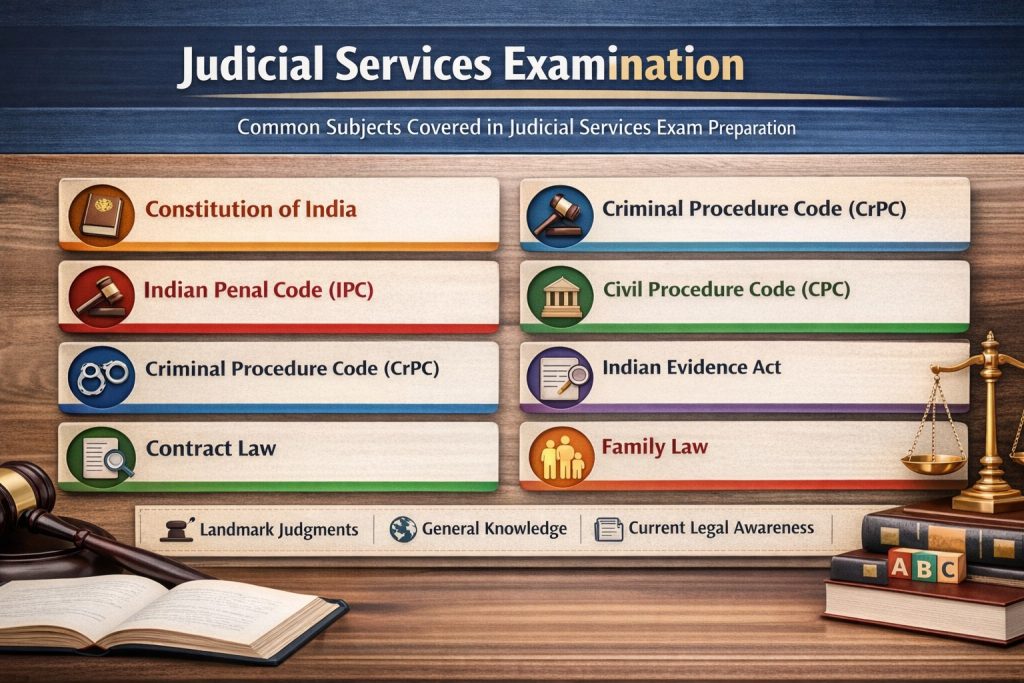
2.4 Common Subjects Covered
A judicial aspirant must prepare for subjects including:
-
Constitution of India
-
Indian Penal Code (IPC)
-
Criminal Procedure Code (CrPC)
-
Civil Procedure Code (CPC)
-
Indian Evidence Act
-
Contract Law
-
Family Law
-
Optional subjects (in some states like Rajasthan)
-
Language and judgment-writing papers
Mindset: The Foundation for Success
Before diving into the books, understand that judiciary preparation is a long-term commitment. Many candidates prepare for 6 months to 2 years, depending on their current knowledge and daily study hours.
Key mindset pillars include:
-
Patience and persistence — The competition is stiff and sustained effort is required.
-
Consistency over intensity — Small daily progress beats sporadic bursts of studying.
-
Develop a positive outlook, especially on tough days.
Creating a Strategic Study Plan
A strategic study plan is the backbone of successful preparation — without it, even bright aspirants struggle.
4.1 Understand the Syllabus in Detail
-
Take a printout of the official syllabus for your state exam.
-
Break it down into subjects and subtopics, noting weightage and priority areas.
-
Identify high-frequency areas like IPC, CrPC, Evidence Act, and Constitution.
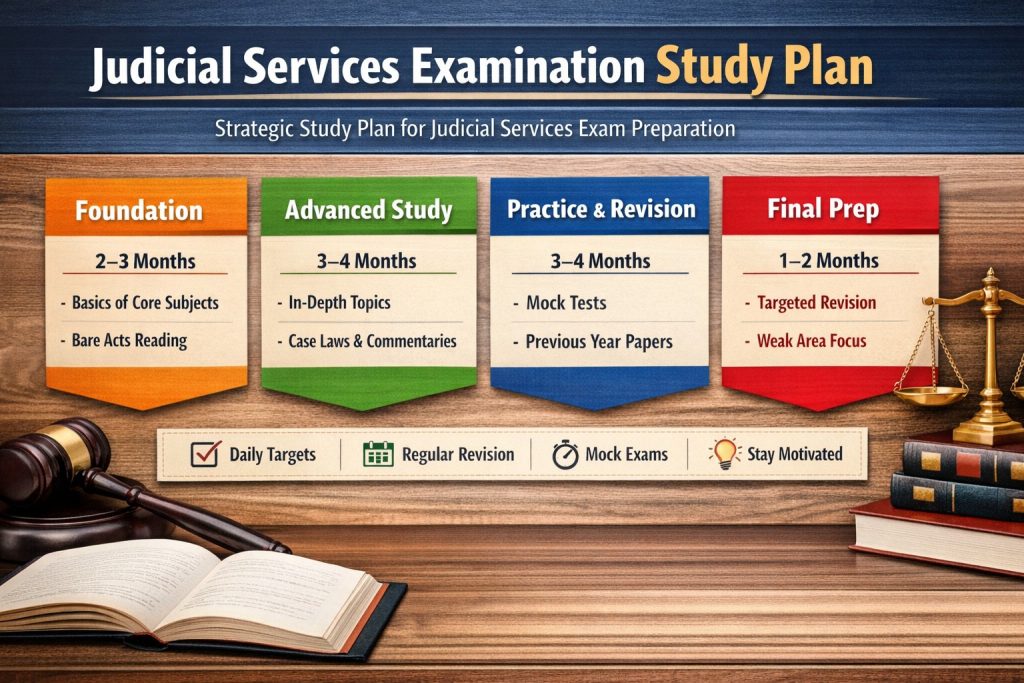
4.2 Allocate Study Time
A general long-term plan (9–12 months) might look like this:
| Phase | Duration | Focus |
|---|---|---|
| Foundation | 2–3 months | Basics of core subjects, bare acts |
| Deep Study | 3–4 months | Advanced topics, case laws, commentary |
| Practice & Revision | 3–4 months | Mock tests, past papers, revisions |
| Final Preparation | 1–2 months | Targeted revision, weak-topic strengthening |
Shorter plans (6 months) require compressed timelines and disciplined daily targets.
4.3 Daily & Weekly Targets
-
Establish a daily routine with fixed hours.
-
Use planners or digital calendars to break the syllabus into daily micro-tasks.
-
Include slots for revision and mock tests.
Core Study Materials for Judicial Services
Your choice of study material will determine the quality of preparation.
5.1 Bare Acts
Bare Acts are the primary source — read them thoroughly, section by section, with notes.
5.2 Standard Commentary Books
Some often-recommended reference books:
-
CPC: Mulla or Halsbury’s
-
IPC: Ratanlal & Dhirajlal
-
CrPC: Kelkar or Takwani
-
Evidence Act: Batuklal
-
Constitution: D.D. Basu or V.N. Shukla
Choose one standard text per subject and avoid collecting too many books. Focus on mastering these well.
5.3 Additional Resources
-
Legal journals & monthly magazines (for current affairs).
-
Online lectures or coaching material (optional).
-
Bare act commentaries for deeper understanding.
How to Study Effectively
6.1 Reading with Understanding (Not Memorization)
Judicial exams test legal reasoning and application, not rote learning. Simply memorizing sections won’t help without understanding how they apply to fact situations.
6.2 Make Effective Notes
-
Summaries of sections and short notes.
-
Flowcharts for complicated subjects.
-
Case-law lists for important judgments.
Effective notes make revision faster and easier.
6.3 Regular Revision is Non-Negotiable
Candidates often underestimate the volume of revision required.
Experts recommend revising each subject multiple times before the exam.
Mock Tests & Previous Year Papers
7.1 Importance of Practice Papers
Regular practice with mock tests and past papers is a cornerstone of preparation for these reasons:
-
Helps you understand question patterns.
-
Improves time management and speed.
-
Builds exam temperament.
-
Identifies weak areas for targeted improvement.
Experts recommend solving at least past 10 years’ papers, especially state-specific ones.
7.2 How to Make Mock Tests Effective
-
Simulate real exam timing.
-
Review answers — not just take tests.
-
Identify recurring errors and correct them.
Mock tests should be taken weekly initially, then more frequently closer to the exam.
Answer Writing Practice
Handling Current Affairs and GK
Judicial exams increasingly include questions on legal current affairs and general legal awareness.
What to Follow
-
Weekly/monthly legal news digests.
-
Landmark judgements from higher courts.
-
Amendments to key laws.
Combine current affairs with your core law preparation rather than treating it as separate.
Language & Regional Paper Preparation
Many states include a language paper (English or local language). Don’t overlook this:
-
Practice essays, precis writing, and translation.
-
Focus on grammar, vocabulary, and legal usage.
-
Solve previous language papers.
This section may carry considerable marks in many states.
Common Mistakes Aspirants Must Avoid
Judicial exam toppers and experts have identified recurring pitfalls:
11.1 Too Many Resources
Many candidates lose focus by reading several books for the same subject. Focus on quality, not quantity.
11.2 Poor Study Plan
Not having a clear plan leads to disorderly preparation and stress later.
11.3 Ignoring Revision
Without revision, retention drops despite studying. Multiple revisions reinforce learning.
11.4 Lack of Practice
Many aspirants read theory but don’t practice writing answers or problem-solving enough.
Coaching vs. Self-Study
Many candidates debate whether coaching is necessary.
Coaching can help with:
-
Structured study plans
-
Regular mock tests
-
Mentor guidance
But self-study can also succeed if disciplined and strategic — coaching is optional but useful for many.
Your choice should depend on finances, learning style, and support structure.
Time Management & Weekly Routine
Sample Daily Routine
| Time | Activity |
|---|---|
| 6:00–8:00 | Core subjects |
| 8:30–9:30 | Revision of previous topics |
| 10:00–1:00 | Mock tests / practice papers |
| 2:00–4:00 | Writing practice / language papers |
| 5:00–7:00 | Current affairs / optional subjects |
Flexible schedules are fine — the key is consistency.
Maintaining Physical & Mental Health
Judicial services preparation is demanding; stress and burnout are common. Maintaining a balanced lifestyle is essential:
-
Adequate sleep.
-
Regular breaks and exercise.
-
Mindfulness and stress-relief practices.
Physical and mental resilience enhances performance.
Delhi Judicial Service Exam
1. What Is the Delhi Judicial Service Exam?
The Delhi Judicial Service Examination is conducted by the Delhi High Court to recruit eligible candidates as judges / civil judicial officers in the Judicial Service of Delhi. The selection process generally includes:
-
Preliminary Examination (objective/MCQ)
-
Mains Examination (descriptive)
-
Viva-Voce / Interview University CUET Exam
2. Expected Application Dates (2025 – 2026)
While the official notification for the 2026 cycle is expected soon, preliminary information from reliable sources (based on past exams and expected timeline) suggests:
| Event | Expected Timeline |
|---|---|
| Notification Release | ~ Aug–Sept 2025 (or early 2026) |
| Online Application Begins | About a week after notification |
| Last Date to Apply | 30–45 days from start of application |
| Prelims Admit Card | 15–20 days before exam |
| Preliminary Exam | Jan–Feb 2026 (expected) |
| Mains / Viva | Later in 2026 |
📌 Official dates vary each year — wait for the official Delhi High Court notification on their website.
3. Eligibility Criteria (Typical Rules)
Before applying, you should ensure you meet all eligibility conditions. These are based on past notifications and expected norms:
✅ Educational Qualification
-
Must have a Bachelor of Laws (LLB) degree from a recognized Indian university.
-
Degree must be recognized by the Bar Council of India. University CUET Exam
✅ Advocate Experience
-
Minimum 3 years of continuous advocate practice is now required before applying for judicial services in most states (including Delhi), following a Supreme Court ruling. The Times of India
✅ Age Limit
-
Usually between 21–32 years (relaxations for reserved categories as per Government rules). University CUET Exam
Note: Age conditions can vary slightly in the official notification.
✅ Nationality
-
Candidate must be an Indian citizen. University CUET Exam
4. How to Apply Online
When the official notification is released, applications are submitted only online via the Delhi High Court’s official website.
📍 Official Portal
👉 https://delhihighcourt.nic.in – This is the official recruitment portal of the Delhi High Court where notifications and online applications are hosted. Delhi District Courts
📌 Steps to Apply (Typical Process)
-
Visit Official Website
-
Go to delhihighcourt.nic.in.
-
-
Find the Notification
-
Look for “Recruitment / Vacancies / Judicial Services Exam” link.
-
-
Read the Full Notification
-
Download and read the PDF thoroughly.
-
Check eligibility, syllabus, exam pattern, fee, and instructions.
-
-
Register / Login
-
Create a login (email + mobile + password).
-
Fill in your details accurately.
-
-
Fill the Application Form
-
Enter name, address, educational details, experience, and other required fields.
-
-
Upload Documents
-
Upload scanned passport photo, signature, advocate enrollment certificate, and other documents as required.
-
-
Pay Application Fee
-
Pay the prescribed fee online (Credit/Debit Card, Net Banking, or UPI).
-
-
Submit & Download
-
Submit the application and download confirmation / print copy for future reference.
-
Note: Some older direct links for applications (for previous cycles) were available online, e.g.:
-
Online form pages from earlier notification: examinationservices.nic.in/recsys23/… — These were used for past Delhi Judicial Service applications. Delhi High Court
5. Application Fee
Fees are set in the official notification. In past exams, fees varied by category:
-
General / Unreserved: Higher fee
-
SC / ST / OBC / PwD: Concessionary fee
Always refer to the latest notification for exact amounts.
6. Important Tips Before Applying
✔ Eligibility Check:
Make sure you satisfy all eligibility conditions before applying (especially years of advocate practice). The Times of India
✔ Document Readiness:
Keep scanned:
-
Photograph
-
Signature
-
Advocate ID / enrollment proof
-
Certificates (education, caste, experience, etc.)
✔ Application Fee Payment:
Fees must be paid before the last date and receipt saved.
✔ Follow Official Notifications Only:
Always rely on the official Delhi High Court website and PDF notifications — NOT third-party summaries.
Where to Watch for the Official Notification
The Delhi High Court publishes all official notifications under the Recruitment section.
🔎 Check here:
👉 https://delhihighcourt.nic.in — Recruitment / Advertisement / Notification section Delhi District Courts
Once the 2026 notification is officially released, that page will have:
-
PDF of the official advertisement
-
Link to apply online
-
Detailed eligibility criteria
-
Exam pattern & syllabus
-
Fee details
-
Important dates & instructions
Summary: Applying for Delhi Judicial Service
| Step | Action |
|---|---|
| 1 | Wait for official notification announcement (likely upcoming) |
| 2 | Check eligibility criteria thoroughly |
| 3 | Visit Delhi High Court official website |
| 4 | Register and fill online application form |
| 5 | Upload documents + pay fee |
| 6 | Submit & download confirmation |
Interview (Viva-Voce) Strategy
If you clear written stages, the interview tests:
-
Legal reasoning.
-
Knowledge of current legal issues.
-
Personality and communication.
Practice mock interviews with peers or mentors.
A Final Word
Judicial Services Exam preparation is a marathon, not a sprint. Success demands discipline, strategy, patience, and adaptability. With the right plan, consistency, and mindset, your dream of becoming a judge can become reality.