

The Complete Story of Law in the Real World
Posted on : 24 December, 2025 2:01 am
The Complete Story of Law in the Real World goes far beyond courtrooms and legal textbooks. Law shapes society, protects rights, drives business decisions, and creates powerful career opportunities in India and abroad. From choosing the right law course to cracking entrance exams, from understanding salary packages to exploring global legal careers—this blog explains law in the real world in the most complete and practical way.
If you are a student considering law, this guide covers everything about law in one place.
Get in Touch with PMCL Law Experts
📞 Call: +7438900900
📧 Email: info@puranmurti.in
🌐 Visit: Puran Murti College of Law Official Website
What Is Law? Understanding Law in the Real World
Law is a system of rules created to regulate society, resolve disputes, and maintain justice. In the real world, law affects:
-
Individual rights and freedoms
-
Business contracts and corporate governance
-
Government policies and administration
-
Social justice, equality, and human rights
-
International relations and global trade
This is why understanding law in the real world is essential—not just for lawyers, but for every citizen.
Why Choose Law as a Career?
Students who choose law often have:
-
Interest in reasoning, logic, and debate
-
Strong communication skills
-
A sense of justice and social responsibility
-
Curiosity about politics, business, or governance
The Complete Story of Law in the Real World shows that law is no longer limited to litigation—it offers diverse and modern career paths.
Eligibility Criteria for Law Courses
BA LLB (5-Year Integrated Course)
-
10+2 from a recognized board
-
Minimum marks:
-
General: 45%
-
OBC: 42%
-
SC/ST: 40%
-
LLB (3-Year Course)
-
Graduation in any stream
-
Same minimum percentage criteria
Law Entrance Exams in India
To enter top colleges, students must clear law entrance tests.
Major Law Entrance Exams
-
CLAT – National Law Universities
-
AILET – NLU Delhi
-
LSAT–India – Private universities
-
CUET (Law) – Central universities
-
State Law CETs – MH CET Law, TS LAWCET, etc.
Law Entrance Exam Syllabus
🎯 Total Questions: 120
⏱ Duration: 2 hours (120 minutes)
📍 Question Type: Multiple-choice questions (MCQs)
➕ Marking Scheme: +1 for correct answer, –0.25 for wrong answer
The CLAT syllabus is divided into five main sections designed to test your comprehension, reasoning, decision-making and basic numerical skills: Consortium of NLUs
📖 English Language (20%)
Focus Areas
-
Reading comprehension passages (400–450 words)
-
Understand central idea, tone, and inference
-
Vocabulary in context (synonyms & antonyms)
-
Grammar: sentence correction, usage, tenses
-
Meaning of phrases & verbal ability skills
-
Summarizing and identifying arguments
✔ Designed to test understanding of written English and ability to interpret texts accurately.
📰 Current Affairs Including General Knowledge (25%)
Focus Areas
-
National & international current events
-
History & culture
-
Indian polity & constitution
-
Economy & finance
-
Science & technology
-
Environment & sustainability
-
International relations & treaties
Passages based on real world situations with MCQs after each.
You must stay updated with newspapers, magazines & current affairs resources.
Legal Reasoning (25%)
This is a core section to judge your legal intuition and application skills.
Important Topics
-
Interpretation of legal principles
-
Passage-based legal problem scenarios
-
Basic legal issues from:
-
Constitution of India
-
Law of Torts
-
Contracts
-
Criminal Law & new criminal statutes
-
Family & property law principles
-
Public policy and ethics issues
-
-
Application of rules to factual situations
🤔 Logical Reasoning (20%)
Focus Areas
-
Argument analysis
-
Assumptions & inference
-
Conclusions & logical structures
-
Patterns & analogies
-
Strengthening or weakening arguments
Passages test how you think and evaluate reasoning, not memorisation.
➗ Quantitative Techniques (10%)
Focus Areas
-
Basic mathematics (10th standard level)
-
Data interpretation: tables, graphs, charts
-
Ratios, percentages, averages
-
Speed & distance, time & work
-
Profit & loss & simple problem solving
This section tests numerical ability and quick interpretation of numerical data.
📊 Section-wise Weightage (Approximate)
| Section | % of Total Marks | Typical Questions |
|---|---|---|
| English Language | ~20% | 22-26 |
| Current Affairs + GK | ~25% | 28-32 |
| Legal Reasoning | ~25% | 28-32 |
| Logical Reasoning | ~20% | 22-26 |
| Quantitative Techniques | ~10% | 10-14 |
Key Preparation Tips
✔ Focus first on Legal Reasoning & Current Affairs — highest weight sections.
✔ Read newspapers (like The Hindu), magazines, GK compendiums.
✔ Practise passage-based questions — especially for English & reasoning.
✔ Build numerical speed with DI sets.
✔ Regular timed mock tests improve accuracy and exam temperament.
How to Prepare for Law Entrance Exams
Preparing for a law entrance exam is not about mugging up facts—it’s about reading smartly, thinking logically, and practicing consistently. With the right strategy, even an average student can crack top law entrance exams.
Step 1: Understand the Exam Pattern & Syllabus
Before starting preparation, know what you’re preparing for.
Common Sections in Law Entrance Exams
-
English Language
-
Legal Reasoning / Legal Aptitude
-
Logical Reasoning
-
General Knowledge & Current Affairs
-
Quantitative Techniques
👉 CLAT & AILET are passage-based, while LSAT focuses more on logical reasoning.
Step 2: Create a Realistic Study Plan
Ideal Preparation Time
-
Class 12 students: 10–12 months
-
Droppers: 6–8 months
Daily Study Time
-
School students: 3–4 hours
-
Droppers: 5–6 hours
Sample Daily Routine
-
45 min – English & reading
-
60 min – Legal reasoning
-
45 min – GK & current affairs
-
30 min – Logical reasoning
-
30 min – Quantitative practice
Step 3: Prepare Section-Wise (Smart Strategy)
📖 English Language
✔ Read editorials, opinion articles
✔ Practice comprehension passages
✔ Learn vocabulary in context (not word lists)
✔ Improve grammar through practice
Best Practice: 2 passages daily
⚖️ Legal Reasoning (Most Important Section)
✔ Understand legal principles given in passages
✔ Focus on application, not prior law knowledge
✔ Practice fact-based legal scenarios
Tip: Don’t assume facts—answer only from the passage.
📰 GK & Current Affairs
✔ Read newspaper daily (The Hindu / Indian Express)
✔ Make short notes (events, laws, judgments)
✔ Cover last 10–12 months thoroughly
Focus Areas
-
Supreme Court judgments
-
New laws & bills
-
International relations
-
Environment & economy
🤔 Logical Reasoning
✔ Practice argument-based questions
✔ Learn to identify assumptions, conclusions
✔ Focus on accuracy, not speed initially
➗ Quantitative Techniques
✔ Revise class 10 basics
✔ Practice data interpretation sets
✔ Learn shortcut methods
Tip: Accuracy matters more than attempting all questions.
Step 4: Choose the Right Study Material
Recommended Books
-
Word Power Made Easy – Norman Lewis
-
Legal Aptitude for CLAT – A.P. Bhardwaj
-
Analytical Reasoning – M.K. Pandey
-
Lucent’s GK + Current Affairs magazine
⚠️ Avoid collecting too many books—quality > quantity.
Step 5: Practice Mock Tests Regularly
Mock Test Strategy
-
Start mocks after 1–2 months of preparation
-
1 mock per week initially
-
2–3 mocks per week in last 3 months
After Every Mock
✔ Analyze wrong answers
✔ Identify weak sections
✔ Improve time management
👉 Mock analysis is more important than mock scores.
Step 6: Improve Speed & Accuracy
-
Attempt easy questions first
-
Skip time-consuming questions
-
Avoid guesswork (negative marking)
-
Practice timed sectional tests
Step 7: Last-Month Revision Strategy
✔ Revise GK notes daily
✔ Practice legal & logical passages
✔ Take full-length mocks every alternate day
✔ Avoid learning new topics
Common Mistakes to Avoid
❌ Ignoring GK until last moment
❌ Studying without a plan
❌ Over-attempting in mocks
❌ Depending only on coaching
❌ Panicking due to mock scores
Recommended Books for Law Entrance Preparation
-
English: Word Power Made Easy – Norman Lewis
-
Legal Aptitude: A.P. Bhardwaj (CLAT Guide)
-
Logical Reasoning: M.K. Pandey
-
GK & Current Affairs: Lucent GK + monthly magazines
-
Essential Prep Books (India Law Entrance)
-
Guide for LLB, CLAT, AILET, SET, DU Law Entrance Exams – Comprehensive guide covering multiple entrance exams and sections (English, GK, Legal Reasoning).
-
24 Topic‑Wise CLAT & AILET (2013‑2024) Previous Year Solved Papers – Topic-wise solved papers to practice past questions and understand exam patterns.
-
Legal Aptitude for CLAT and Other LLB Entrance Examinations – Focused book for legal aptitude and reasoning (excellent for building core legal principles).
-
10 Previous Years CLAT & AILET (2013‑2022) Topic‑Wise Solved Papers – Another solved paper resource to reinforce practice.
-
LLB vs BA LLB: Which Is Better?
Choosing between LLB and BA LLB is one of the most important decisions for students planning a career in law. Both degrees lead to becoming a lawyer, judge, corporate professional, or legal expert — but they differ in structure, eligibility, duration, and career exposure. Let’s understand LLB vs BA LLB in detail so you can choose the right path for your future.
What is LLB?
LLB (Bachelor of Laws) is a 3-year law degree pursued after graduation in any discipline (BA, BCom, BSc, etc.).
Key Highlights:
-
Duration: 3 years
-
Eligibility: Graduation completed
-
Focus: Core law subjects only
-
Ideal for: Graduates who decide to enter law later
Subjects Include:
-
Constitutional Law
-
Criminal Law
-
Contract Law
-
Company Law
-
Civil & Criminal Procedure
-
Jurisprudence
What is BA LLB?
BA LLB is a 5-year integrated law course pursued after Class 12. It combines law subjects with humanities like political science, sociology, and economics.
Key Highlights:
-
Duration: 5 years
-
Eligibility: 10+2 pass
-
Focus: Law + social sciences
-
Ideal for: Students certain about law from an early stage
Subjects Include:
-
Political Science
-
Sociology
-
Economics
-
History
-
All core law subjects (same as LLB)
LLB vs BA LLB – Quick Comparison Table
| Basis | LLB | BA LLB |
|---|---|---|
| Course Duration | 3 Years | 5 Years |
| Eligibility | Graduation | 10+2 |
| Course Type | Law-only | Integrated (Arts + Law) |
| Entry Level | After college | After school |
| Depth of Social Sciences | Limited | Strong |
| Career Scope | Excellent | Excellent |
| Litigation Advantage | High | High |
| Corporate Law | Yes | Yes |
| Judiciary Preparation | Yes | Yes |
Which Is Better: LLB or BA LLB?
✅ Choose BA LLB if:
-
You are sure about law after 12th
-
You want strong foundation in social sciences
-
You aim for judiciary, civil services, or policy roles
-
You prefer early entry into the legal profession
✅ Choose LLB if:
-
You discovered interest in law after graduation
-
You already hold a degree in commerce, science, or arts
-
You want a shorter law course
-
You plan to switch careers into law
👉 Career outcomes after both courses are almost the same — success depends more on skills, internships, college quality, and exposure than the degree name.
Top Law Colleges in India
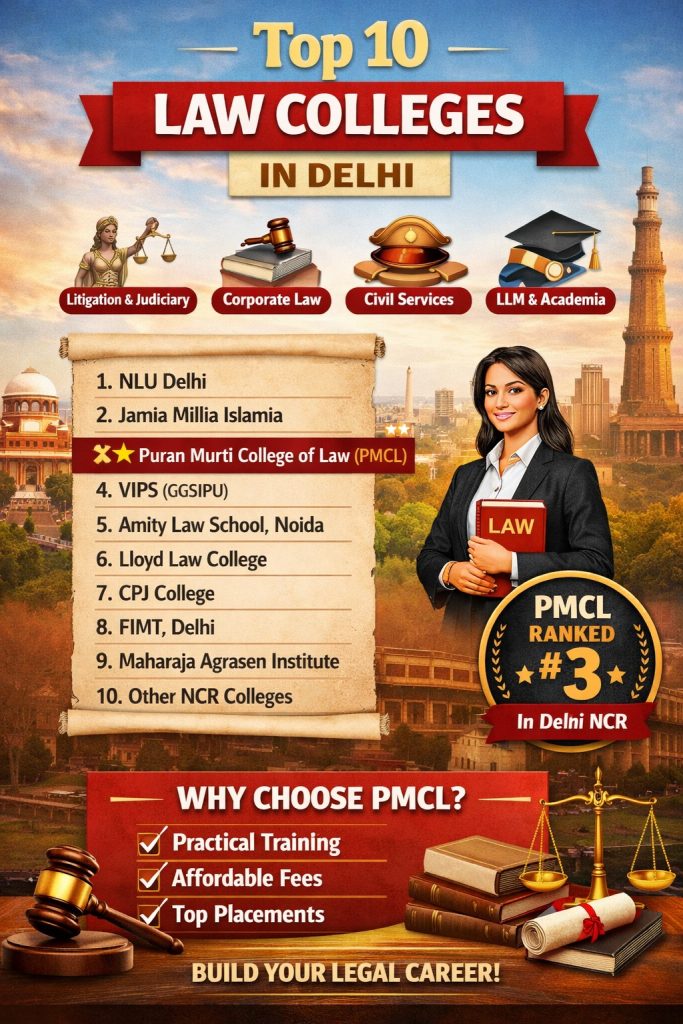
National Law Universities
-
NLSIU Bengaluru
-
NALSAR Hyderabad
-
WBNUJS Kolkata
-
NLU Jodhpur
-
NLU Delhi
Other Reputed Colleges
-
Faculty of Law, Delhi University
-
Symbiosis Law School
-
Jindal Global Law School
-
BCI-approved government & private colleges
How PMCL Prepares You for Law Careers
At Puran Murti College of Law (PMCL), legal education goes beyond textbooks and exams. PMCL focuses on preparing students for real law careers in courts, corporate offices, government services, and global platforms. The goal is to shape confident, skilled, and ethical legal professionals who understand law in the real world.
1. Strong Academic Foundation in Core Law Subjects
PMCL follows a structured curriculum aligned with Bar Council of India (BCI) guidelines, ensuring students gain deep conceptual clarity in:
-
Constitutional Law
-
Criminal Law (IPC, CrPC)
-
Contract Law
-
Family Law
-
Property Law
-
Company & Corporate Law
This solid academic base is essential for careers in litigation, corporate law, judiciary, and higher studies.
2. Practical Training Through Moot Courts & Case Studies
PMCL emphasizes learning by doing, helping students develop courtroom confidence.
Students participate in:
-
Regular moot court sessions
-
Case law analysis and judgment writing
-
Legal drafting and pleading practice
-
Argument presentation and rebuttal skills
These activities prepare students for court practice, internships, and competitive exams.
3. Internship & Real-World Legal Exposure
PMCL encourages and supports students to gain hands-on experience through:
-
Court internships under practicing advocates
-
Exposure to law firms and legal offices
-
Legal aid clinics and awareness camps
Internships help students understand professional ethics, client handling, and procedural law—key aspects of a successful law career.
4. Career Guidance & Mentorship
PMCL provides continuous academic and career mentoring to help students choose the right path:
-
Guidance for litigation vs corporate careers
-
Orientation for judicial services preparation
-
Advice on higher studies (LLM, PhD, diplomas)
-
Awareness about career opportunities in India and abroad
This personalized support helps students plan their careers early and wisely.
5. Skill Development for Modern Legal Careers
Modern legal careers require more than legal knowledge. PMCL focuses on building:
-
Legal research and writing skills
-
Communication and negotiation abilities
-
Analytical and critical thinking
-
Professional ethics and discipline
These skills are essential for corporate law, compliance roles, arbitration, and international legal practice.
6. Exposure to Law in the Modern World
PMCL introduces students to emerging and high-growth legal fields such as:
-
Corporate and Business Law
-
Cyber Law and Data Protection
-
Intellectual Property Rights (IPR)
-
Environmental and Technology Law
This exposure ensures students are future-ready and adaptable to changing legal landscapes.
7. Preparation for Government & Judicial Careers
For students aiming at government legal roles, PMCL builds a strong base for:
-
Judicial Services (PCS-J, DJS)
-
Public Prosecutor roles
-
Legal Officer positions in PSUs
Regular academic discussions, legal reasoning exercises, and conceptual clarity support long-term competitive exam preparation.
8. Ethical & Professional Values
PMCL believes that a successful lawyer must be:
-
Ethically strong
-
Socially responsible
-
Professionally disciplined
The institution instills values of integrity, respect for the law, and commitment to justice—qualities that define respected legal professionals.
9. Support for Careers Abroad & Higher Studies
PMCL guides students interested in:
-
LLM in India or abroad
-
International law and arbitration
-
Corporate and business law careers overseas
Students are advised on specialization choices, skill development, and academic pathways for global legal opportunities.
10. A Career-Oriented Learning Environment
With experienced faculty, academic mentoring, and practical exposure, PMCL creates a learning ecosystem where students are prepared for:
-
Courts
-
Corporate legal departments
-
Government services
-
Academia and research
-
International legal platforms
Subjects Taught in Law Courses
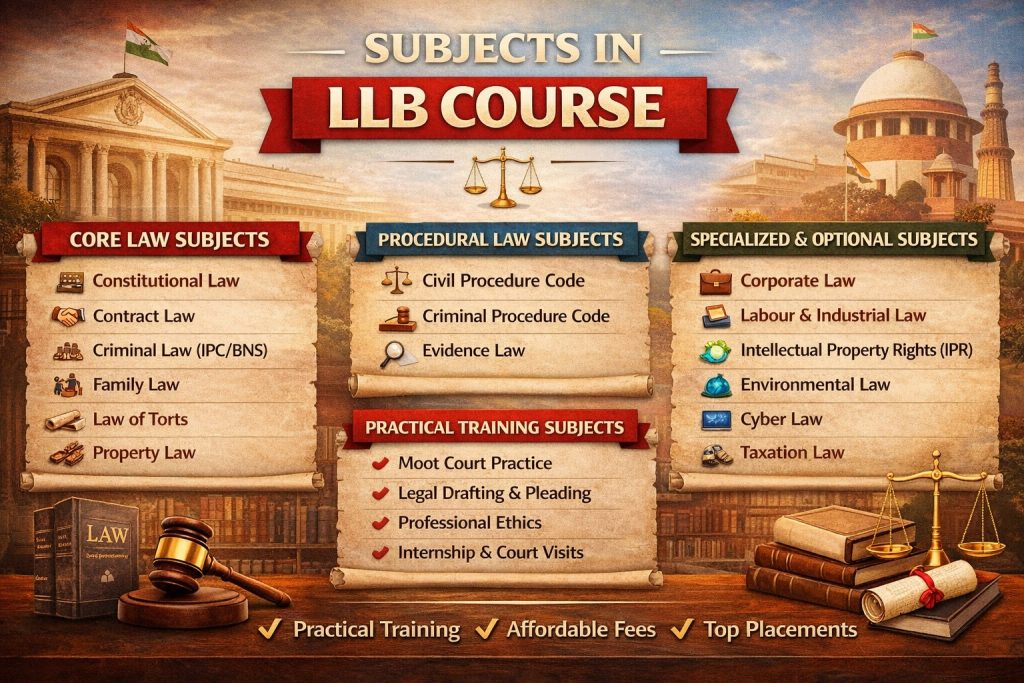
-
Constitutional Law
-
Criminal Law
-
Contract Law
-
Family Law
-
Property Law
-
Company Law
-
Labour Law
-
Environmental Law
-
Moot Courts & Legal Writing
for full syllabus Click Here
These subjects build practical understanding of the complete story of law in the real world.
Career Opportunities After LLB / BA LLB
1. Litigation (Court Practice)
-
Role: Advocate / Trial Lawyer
-
Work Area: District Courts, High Courts, Supreme Court
-
Specializations: Criminal law, Civil law, Family law, Constitutional law
-
Growth: Starts as a junior advocate → independent practice
-
Best For: Students who enjoy arguing cases and court work
2. Corporate Lawyer
-
Role: Legal Associate, In-House Counsel
-
Work Area: Companies, MNCs, law firms
-
Key Areas: Corporate law, M&A, IPR, Contract law, Compliance
-
Salary: ₹4–12 LPA (higher with experience)
-
Best For: Students preferring office jobs & high salaries
3. Judicial Services (Judge)
-
Exam: Judicial Services Exam (PCS-J)
-
Role: Civil Judge / Judicial Magistrate
-
Salary: ₹7–15 LPA + government perks
-
Best For: Academically strong students with patience
4. Government Jobs
-
Exams: UPSC, State PSC, SSC, Banking
-
Roles:
-
Public Prosecutor
-
Legal Officer
-
Assistant District Attorney
-
Law Officer in PSUs (ONGC, BHEL, etc.)
-
5. Academics & Teaching
-
Path: BA LLB → LLM → NET
-
Role: Law Professor / Lecturer
-
Work Area: Universities & law colleges
-
Best For: Students interested in teaching & research
6. Legal Journalism & Media
-
Roles: Legal Reporter, Content Writer, Legal Analyst
-
Platforms: News channels, legal websites, magazines
-
Best For: Students with strong writing & analysis skills
7. International Career
-
Options:
-
LLM abroad (UK, USA, Canada)
-
International law firms
-
NGOs & International Organizations
-
-
Areas: Human rights, International trade law
8. Company Secretary (CS) + Law
-
Why Combine: High demand in corporate governance
-
Roles: Compliance Officer, Corporate Advisor
9. Alternative Legal Careers
-
Legal Advisor
-
Arbitrator / Mediator
-
Policy Analyst
-
Legal Consultant
-
Legal Tech Professional
Which Career is Best After BA LLB?
| Interest | Best Career Option |
|---|---|
| Court practice | Litigation |
| High salary | Corporate Law |
| Government service | Judiciary / PSU jobs |
| Teaching & research | Academics |
| Writing & media | Legal Journalism |
Career Abroad After Law
One of the most exciting parts of the complete story of law in the real world is global career opportunities.
Popular Countries for Law Careers
-
UK – Solicitor, Barrister
-
USA – Corporate law, legal consultancy
-
Canada – Legal advisor, immigration law
-
Australia – Commercial & international law
-
UAE & Singapore – Corporate & arbitration roles
How to Work Abroad After Law
-
LLM from a foreign university
-
Clear country-specific bar exams
-
Specialize in international, corporate, or business law
Top Specializations for Global Careers
-
International Business Law
-
Arbitration & Mediation
-
Intellectual Property Rights
-
Cyber & Technology Law
Salary Packages After Law
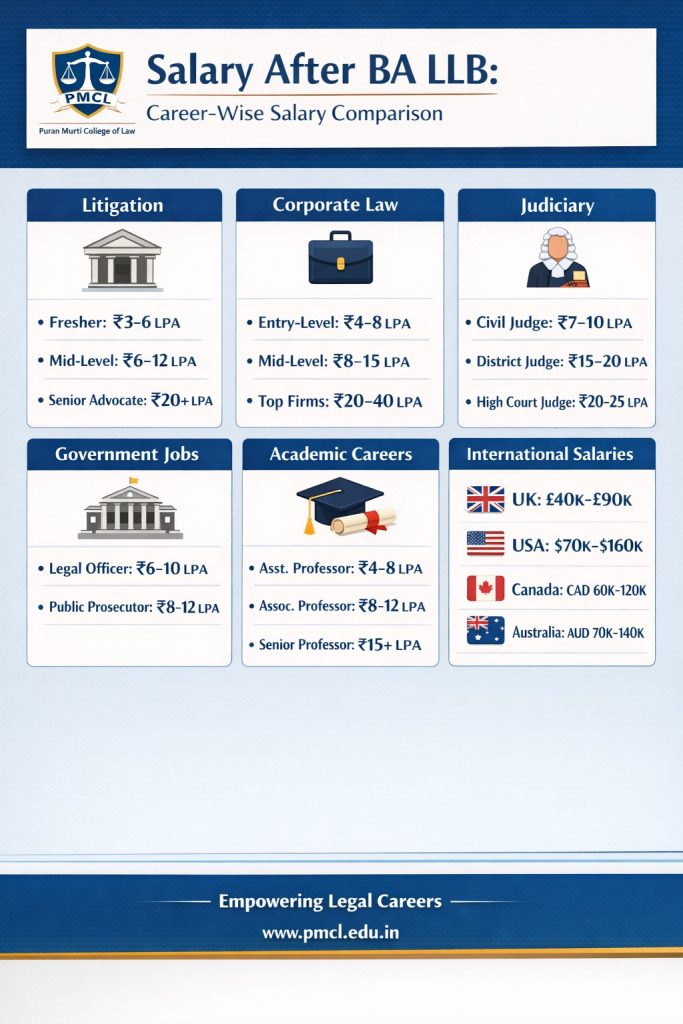
Freshers
-
Litigation: ₹15,000–₹30,000/month
-
Corporate law: ₹3–6 LPA
Mid-Level
-
₹8–20 LPA (corporate & consultancy roles)
Abroad
-
UK/Canada: ₹40–80 LPA (approx.)
-
USA: ₹70 LPA – ₹1 Cr+
| Career Path | Salary Range |
|---|---|
| Litigation (Initial) | ₹20,000 – ₹40,000/month |
| Corporate Lawyer | ₹4– 15 LPA |
| Judicial Services | ₹7 – 20 LPA |
| PSU Legal Officer | ₹6 – 20 LPA |
| Law Firms (Top Tier) | ₹12 – 25+ LPA |
| Career Abroad | ₹30 – 60 LPA (after LLM & licensing) |
Quick Visual Comparison
| Career | Income Potential | Stability | Courtroom Work |
|---|---|---|---|
| Litigation | ⭐⭐⭐⭐ | ⭐⭐ | ✔ Yes |
| Judiciary | ⭐⭐⭐ | ⭐⭐⭐⭐⭐ | ✔ Yes |
| Corporate Law | ⭐⭐⭐⭐⭐ | ⭐⭐⭐ | ✖ No |
| Legal Advisor | ⭐⭐⭐ | ⭐⭐⭐⭐ | ✖ No |
| Public Prosecutor | ⭐⭐⭐ | ⭐⭐⭐⭐ | ✔ Yes |
| Govt / PSU | ⭐⭐⭐ | ⭐⭐⭐⭐⭐ | ✖ No |
| LLM & Academia | ⭐⭐ | ⭐⭐⭐⭐ | ✖ No |
Higher Studies After Law
-
LLM (India or Abroad)
-
Judicial Services Preparation
-
PhD in Law
-
Specialized Diplomas (IPR, Cyber Law, Corporate Law)
Law in the Modern World
Law today intersects with technology, business, and global systems.
Emerging Law Fields
-
Cyber & Data Protection Law
-
AI & Technology Law
-
Environmental & Climate Law
-
Startup & FinTech Law
-
Space & Aviation Law
This evolution defines law in the real world today.
Tips for Students Choosing an LLB College
-
Always check BCI approval
-
Prefer colleges with practical training
-
Choose affordable options with good exposure
-
Focus on internships, not just placements
-
Start career planning early
Confused? Get Career Guidance from PMCL Law Experts
Not sure which career path to choose after LLB or BA LLB?
Puran Murti College of Law (PMCL) https://puranmurtilaw.com/ provides expert career guidance to help students choose the right legal career—litigation, judiciary, corporate law, government jobs, or higher studies.
Our experienced faculty supports students with:
-
👉 Career options after LLB
-
👉 Guidance for BA LLB courses at PMCL
-
👉 Preparation for Judicial Services after LLB
-
👉 Internship & placement support through our Law Programs
-
👉 Advice on LLM & higher studies
Get in Touch with PMCL Law Experts
📞 Call: +7438900900
📧 Email: info@puranmurti.in
🌐 Visit: Puran Murti College of Law Official Website
👉 Apply Now for Law Courses at PMCL
👉 Book Free Career Counseling Session
Conclusion: The Complete Story of Law in the Real World
The Complete Story of Law in the Real World is about knowledge, responsibility, growth, and opportunity. Law offers respect, stability, global exposure, and the power to create change. With the right preparation and mindset, a law degree can open doors across courts, corporations, governments, and countries.