

Law Career Abroad vs India
Posted on : 4 January, 2026 1:13 am
Choosing between a law career in India or abroad is one of the most important decisions for law aspirants today. With globalization, cross-border transactions, international arbitration, and rising demand for compliance and regulatory experts, law has become a truly global profession. However, the career structure, earnings, education pathways, competition, and lifestyle differ significantly between India and foreign countries.
This in-depth guide compares law as a career abroad vs in India using facts, data trends, tables, and practical insights to help students make an informed decision.
Get in Touch with PMCL Law Experts
📞 Call: 7438900900
📧 Email: info@puranmurti.in
🌐 Visit: Puran Murti College of Law Official Website
What BA LLB Students Should Know Early
For BA LLB aspirants, the choice between India and abroad must be made strategically and early. A 5-year integrated law course gives students enough time to:
-
Build strong academic foundations
-
Develop internships portfolios
-
Explore litigation, corporate law, and policy work
-
Prepare for international opportunities like LLM or JD
Best Path for BA LLB Students
| Goal | Recommended Path |
|---|---|
| Litigation / Judiciary | BA LLB in India + Court Internships |
| Corporate Law (India) | BA LLB + Tier-1 Firm Exposure |
| International Law | BA LLB + LLM Abroad |
| Policy / Think Tanks | BA LLB + Research + Higher Studies |
📌 Key Advice:
BA LLB students should not rush abroad immediately after 12th. India provides stronger foundational exposure at the undergraduate level.
LLB Aspirants: Career-Focused Decisions
LLB students usually:
-
Already hold a graduation degree
-
Are more career-oriented
-
Want quicker professional entry
For them, decisions must be ROI-driven and time-sensitive.
Best Path for LLB Students
| Background | Best Option |
|---|---|
| Commerce / Business | Corporate Law / Compliance |
| Humanities | Policy, Research, Academia |
| Science / Tech | IP Law, Tech Law |
| Working Professionals | LLB + In-house Counsel |
LLB Abroad vs India – Special Insight
-
LLB abroad is rare and expensive
-
LLM or JD is more practical for LLB graduates
-
India offers faster courtroom and practice entry
📌 Key Advice:
LLB students should go abroad only with specialization clarity, not general law.
Global Overview of the Legal Profession
The legal profession globally is influenced by:
-
Economic growth
-
Corporate activity
-
Government regulation
-
Technological transformation
-
Cross-border trade and disputes
India
India has one of the largest legal systems in the world, with:
-
Over 1.4 million registered advocates
-
More than 1,700 law colleges
-
A strong litigation-oriented culture
-
Growing corporate and regulatory legal markets
Abroad (USA, UK, Canada, Australia, Europe)
Developed economies have:
-
Mature legal markets
-
Strong corporate law dominance
-
Highly regulated legal education and licensing
-
High demand for specialists in technology, finance, and international law
Legal Education Pathways: India vs Abroad
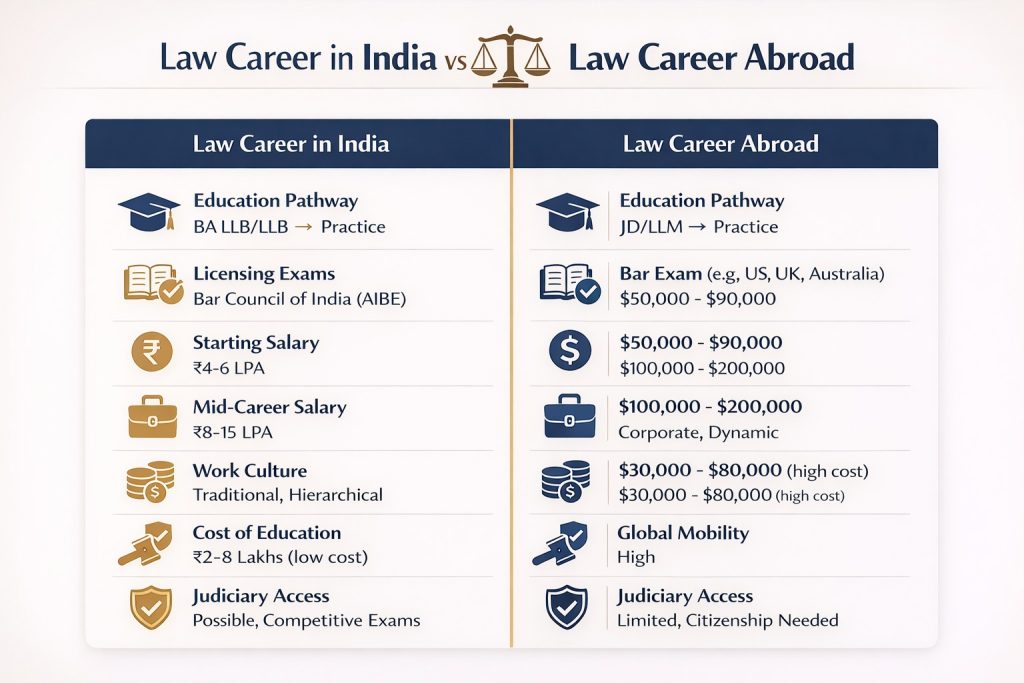
A. Law Courses in India
| Course | Duration | Eligibility | Career Outcome |
|---|---|---|---|
| BA LLB | 5 years | After Class 12 | Litigation, corporate law, judiciary |
| BBA LLB | 5 years | After Class 12 | Corporate law, compliance |
| BCom LLB | 5 years | After Class 12 | Taxation, finance law |
| LLB | 3 years | After graduation | Litigation, corporate roles |
| LLM | 1 year | After LLB | Specialization, academics |
| PhD in Law | 3–5 years | LLM | Research, teaching |
-
CLAT (NLUs)
-
AILET
-
State CETs
-
All India Bar Examination (AIBE)
B. Law Courses Abroad
| Country | Primary Law Degree | Post-Degree Requirement |
|---|---|---|
| USA | JD (Juris Doctor) | State Bar Exam |
| UK | LLB / GDL | SQE / Bar Training |
| Canada | JD | Provincial Bar Exam |
| Australia | LLB / JD | Practical Legal Training |
| Europe | LLB + LLM | Country-specific licensing |
Popular International Specializations
-
International Business Law
-
Intellectual Property Law
-
International Arbitration
-
Human Rights Law
-
Energy & Environmental Law
-
Technology & Data Protection Law
-
Banking & Financial Law
Top Law Colleges: India vs Abroad
Top Law Colleges in India
| Institution | Location | Known For |
|---|---|---|
| NLSIU | Bengaluru | Corporate & litigation |
| NALSAR | Hyderabad | Research & policy |
| PMCL | Sonipat | Affordable & Practical |
| NLU Delhi | Delhi | Litigation & judiciary |
| Symbiosis Law School | Pune | Corporate exposure |
| Jindal Global Law School | Sonipat | International collaborations |
Top Law Colleges Abroad
| Country | University | Strength |
|---|---|---|
| USA | Harvard Law School | Global corporate law |
| USA | Yale Law School | Policy & academia |
| UK | Oxford University | Jurisprudence |
| UK | Cambridge University | International law |
| UK | LSE | Corporate & finance law |
| Canada | University of Toronto | Business law |
| Australia | University of Melbourne | Commercial law |
Cost of Legal Education
| Country | Average Tuition Cost |
|---|---|
| India | ₹2–10 lakhs (total) |
| USA | ₹50–70 lakhs (JD) |
| UK | ₹30–45 lakhs |
| Canada | ₹25–40 lakhs |
| Australia | ₹30–50 lakhs |
📌 Insight: Law education abroad is a high-investment decision, while India offers relatively low-cost legal education with long-term returns.
Salary Comparison: India vs Abroad
Starting Salaries
| Location | Entry-Level Salary |
|---|---|
| India (avg) | ₹3–8 LPA |
| India (top firms) | ₹12–18 LPA |
| USA | ₹70–95k/year |
| UK | £40k–£90k |
| Canada | CAD 70k–100k |
| Australia | AUD 70k–110k |
Mid-Career & Senior Earnings
| Career Stage | India | Abroad |
|---|---|---|
| 5–7 years | ₹25–60 LPA | ₹1–3 Cr equivalent |
| Partner/Senior | ₹1 Cr+ | ₹4–10 Cr+ |
📌 Key Difference:
Abroad offers faster financial growth, while India offers long-term earnings potential with reputation and specialization.
Career Options After Law: India vs Abroad
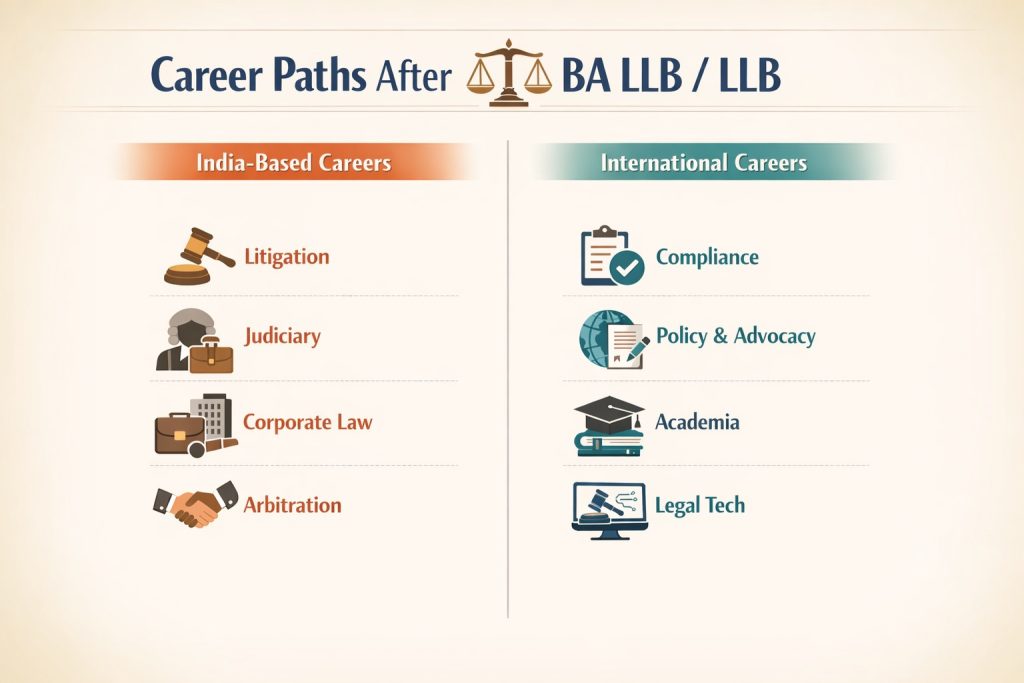
Career Options in India
-
Litigation (Courts & Tribunals)
-
Corporate Law Firms
-
Judiciary (Civil Judge, Higher Judicial Services)
-
In-House Counsel
-
Legal Process Outsourcing (LPOs)
-
Policy & Government Services
-
Academia & Research
-
Legal Journalism
-
NGO & Human Rights Work
Career Options Abroad
-
Corporate Law Firms
-
International Arbitration
-
Compliance & Risk Management
-
Banking & Financial Regulation
-
Intellectual Property Law
-
Immigration Law
-
Public Policy Think Tanks
-
International Organizations (UN, WTO)
Competition & Employability
India
-
Large number of graduates
-
Placements concentrated in top colleges
-
Litigation success depends on experience and mentorship
-
Corporate law highly competitive
Abroad
-
Fewer graduates per capita
-
Strong campus recruitment
-
Visa and work permit restrictions
-
High licensing standards
Work Culture & Lifestyle
| Aspect | India | Abroad |
|---|---|---|
| Work Hours | Variable | Structured |
| Job Security | Experience-based | Contract-based |
| Work-Life Balance | Depends on field | Generally better |
| Professional Mobility | Limited | High |
Global Recognition & Mobility
-
Indian law degrees have limited direct recognition abroad
-
Foreign-qualified lawyers enjoy global mobility
-
LLM from reputed universities improves international prospects
-
Cross-qualification is common abroad
Future Trends in Law Careers
Global Trends
-
AI & Legal Tech
-
ESG & Sustainability Law
-
Data Privacy & Cyber Law
-
Cross-Border M&A
-
International Arbitration
Indian Trends
-
Startup & FinTech regulation
-
Insolvency & Bankruptcy Law
-
Taxation & GST Law
-
Infrastructure & Energy Law
Who Should Choose Law Abroad?
✔ Students aiming for corporate or international law
✔ Those with strong academic records
✔ Aspirants seeking high salaries early
✔ Individuals comfortable with licensing & visas
Who Should Choose Law in India?
✔ Students interested in litigation or judiciary
✔ Those seeking entrepreneurship in law
✔ Candidates with long-term career vision
✔ Aspirants preferring lower education cost
Bar Council Regulations & Licensing Differences
One of the most critical yet overlooked aspects of choosing between a law career in India or abroad is professional licensing. In India, a law graduate must clear the All India Bar Examination (AIBE) to practice in courts. Once enrolled with a State Bar Council, advocates can practice across India, making mobility within the country relatively easy.
In contrast, foreign jurisdictions operate under strict licensing frameworks. The USA requires state-specific bar exams, the UK mandates SQE or Bar training, and countries like Canada and Australia have provincial licensing. These regulations create higher entry barriers but also ensure standardized professional competence, which enhances global credibility.
Litigation vs Corporate Law: Geography Matters
India is traditionally a litigation-dominated legal market. Courts, tribunals, and quasi-judicial bodies provide long-term career stability, particularly for those aspiring to the judiciary or senior advocacy roles.
Abroad, however, the legal profession is largely corporate-driven. Corporate law firms handle mergers, acquisitions, compliance, finance, and international arbitration. Litigation exists but is often more specialized and less personality-driven compared to Indian court practice.
📌 Key Insight:
If courtroom advocacy excites you, India offers broader opportunities. If transactional law and structured corporate roles attract you, foreign jurisdictions provide better platforms.
Judiciary & Public Service Opportunities
India offers a unique advantage in terms of judicial services. Law graduates can appear for:
-
Civil Judge Exams
-
Higher Judicial Services
-
Public Prosecutor roles
-
Legal officers in PSUs
Such career paths are largely unavailable to foreign-qualified lawyers. Abroad, judicial appointments usually require many years of practice, citizenship, and political vetting, making them less accessible to international candidates.
Impact of Artificial Intelligence on Law Careers
AI and automation are transforming legal careers worldwide. Tasks such as document review, legal research, and contract drafting are increasingly automated.
Abroad, law firms are rapidly adopting legal tech platforms, increasing demand for lawyers skilled in:
-
Legal analytics
-
AI compliance
-
Data protection laws
India is catching up, especially in legal process outsourcing (LPOs) and legal-tech startups, offering new-age roles that blend law with technology.
Language & Cultural Influence on Legal Practice
Language plays a vital role in legal success. In India, regional language proficiency can significantly impact litigation careers, especially in district courts.
Abroad, strong command over legal English and cultural sensitivity is essential. Understanding business etiquette, negotiation styles, and legal drafting standards of a country can influence career progression more than academic scores.
Taxation & Cost of Living Adjustments
While salaries abroad appear significantly higher, purchasing power parity and cost of living must be considered. Cities like New York, London, and Toronto have high rent, taxes, and healthcare costs.
India, with lower living expenses, allows lawyers to retain a larger portion of earnings over time, especially once practice stabilizes.
Gender Representation & Inclusivity in Law
Foreign jurisdictions have made measurable progress in:
-
Gender diversity in law firms
-
Pay parity
-
Workplace harassment regulations
India is improving but still faces challenges such as:
-
Limited women representation in senior advocacy
-
Work-life balance concerns in litigation
However, Indian corporate law firms are emerging as leaders in diversity initiatives.
Scholarships, Financial Aid & Education Loans
Foreign law schools offer:
-
Merit-based scholarships
-
Diversity grants
-
Need-based financial aid
However, competition is intense. Indian law schools have limited scholarship structures, but education loans are more accessible and less financially risky.
Role of Internships & Clerkships
Internships are the backbone of legal employability.
-
In India, internships during law school significantly impact litigation exposure and corporate placements.
-
Abroad, clerkships and structured internships are often mandatory and heavily influence job offers.
Foreign law schools emphasize career services, which gives students a strategic advantage.
Networking & Alumni Power
Abroad, alumni networks play a decisive role in recruitment and career growth. Law firms often prefer candidates from known institutions.
In India, networking is equally important but more relationship-driven, especially in litigation and chambers of senior advocates.
Entrepreneurship & Independent Practice
India offers greater flexibility to start:
-
Independent law chambers
-
Boutique law firms
-
Legal startups
Abroad, independent practice requires:
-
Additional licensing
-
Capital
-
Compliance with strict regulations
Thus, India provides lower entry barriers for legal entrepreneurship.
Ethical Standards & Professional Accountability
Ethical standards and professional accountability form the backbone of the legal profession, ensuring public trust, fairness, and integrity in the justice system. Whether a lawyer practices in India or abroad, adherence to ethical principles is non-negotiable, but the structure, enforcement, and consequences of ethical violations differ significantly across jurisdictions.
In India, ethical conduct of lawyers is governed by the Advocates Act, 1961 and the Bar Council of India (BCI) Rules. Lawyers are expected to maintain client confidentiality, avoid conflicts of interest, act with honesty toward courts, and uphold the dignity of the profession. Disciplinary control lies with the State Bar Councils, which can impose penalties ranging from reprimands and suspension to disbarment. However, enforcement in India is often criticized for being slow and inconsistent, largely due to procedural delays and varying standards across states. Despite this, senior advocates and reputed law firms maintain strong internal ethical norms to preserve professional credibility.
In contrast, foreign jurisdictions such as the USA, UK, Canada, and Australia operate under highly regulated and strictly enforced ethical frameworks. Lawyers must comply with detailed professional conduct rules issued by bar associations or regulatory bodies like the American Bar Association (ABA) or the Solicitors Regulation Authority (SRA) in the UK. Mandatory requirements such as professional indemnity insurance, continuous legal education (CLE), and regular compliance audits ensure accountability. Ethical breaches can result in immediate suspension, heavy fines, or permanent disqualification, with decisions often publicly recorded.
A key difference lies in client protection and transparency. Abroad, clients have greater access to grievance redressal mechanisms and compensation for professional negligence. In India, while accountability mechanisms exist, awareness and enforcement remain evolving.
Foreign jurisdictions enforce strict ethical compliance, including:
-
Malpractice insurance
-
Professional misconduct penalties
India follows ethical standards under the Advocates Act, but enforcement varies across regions.
Long-Term Career Stability & Retirement
Long-term career stability and retirement prospects are crucial considerations when choosing between a law career in India or abroad. The legal profession offers longevity in both systems, but the nature of stability and post-retirement security differs significantly.
In India, law is often viewed as a lifetime profession. Advocates can practice well into their 60s and 70s, especially in litigation, arbitration, and advisory roles. Senior lawyers continue to earn based on reputation, experience, and clientele rather than age. Many advocates also transition into roles such as mediators, arbitrators, legal advisors, or judicial appointments, ensuring sustained professional relevance. However, India lacks a structured retirement or pension system for most lawyers, making personal financial planning essential.
In contrast, lawyers abroad typically work within firm-based or corporate structures that offer defined career trajectories. While performance-driven environments may limit longevity in high-pressure roles, professionals benefit from structured retirement plans, employer-sponsored pensions, and social security systems. Many lawyers move into academia, consultancy, or in-house roles as they approach retirement age.
Psychological Stress & Mental Health in Legal Careers
Mental health awareness is stronger abroad, with:
-
Counseling services
-
Reduced stigma
India’s legal profession is gradually acknowledging burnout, especially among litigators and junior associates.
Role of Law in Policy Making & Governance
Indian lawyers often transition into:
-
Politics
-
Policy advisory roles
-
Constitutional offices
Abroad, policy influence is more institutionalized through think tanks and government agencies.
Final Decision Matrix
| Factor | India | Abroad |
|---|---|---|
| Cost of Education | Low | High |
| Entry Barriers | Moderate | High |
| Salary Growth | Slow–Steady | Fast |
| Judiciary Access | High | Low |
| Global Mobility | Limited | High |
| Entrepreneurship | Easy | Complex |
Case Studies: Indian Lawyers vs Foreign Lawyers
Case Study 1: Indian Litigation Lawyer
Profile:
-
Name: Rohit Sharma
-
Education: BA LLB (NLU)
-
Career Choice: Litigation in Delhi High Court
Career Journey:
Rohit started his career under a senior advocate earning ₹15,000–₹25,000/month during the first two years. His initial phase involved drafting, court appearances, and extensive legal research. By the 5th year, he began handling independent matters and earned around ₹12–15 LPA through retainers and appearances.
At 10+ years, Rohit became a well-recognized counsel in commercial disputes and arbitration, with annual earnings crossing ₹1 crore, along with professional respect and courtroom authority.
Key Takeaway:
👉 India rewards patience, reputation, and courtroom skill over time.
Case Study 2: Indian Corporate Lawyer
Profile:
-
Name: Ananya Verma
-
Education: BBA LLB (Top private law school)
-
Career Choice: Corporate Law Firm in Mumbai
Career Journey:
Ananya joined a Tier-1 firm at ₹14 LPA. Her workload included M&A due diligence, contracts, and regulatory compliance. By year 5, she moved to an international firm’s India desk, earning ₹35–40 LPA.
However, long working hours and high pressure led her to transition into an in-house counsel role, offering better work-life balance at ₹30 LPA.
Key Takeaway:
👉 India’s corporate law offers high earnings but demands endurance.
Case Study 3: Foreign Lawyer (USA)
Profile:
-
Name: Michael Brown
-
Education: JD – Top 20 US Law School
-
Career Choice: Corporate Associate, New York
Career Journey:
Michael graduated with education debt but secured a job at a global law firm earning $190,000 (~₹1.6 crore) annually. Within 5 years, his compensation crossed $350,000 including bonuses.
Despite financial success, long workweeks (70–80 hours) resulted in burnout. Michael later moved to a regulatory role with reduced pay but better mental health.
Key Takeaway:
👉 Foreign legal careers offer fast financial growth but intense pressure.
Case Study 4: Indian Student with Foreign LLM
Profile:
-
Name: Sneha Kapoor
-
Education: BA LLB (India) + LLM (UK)
Career Journey:
Sneha pursued an LLM in International Commercial Law from the UK. She did not qualify as a solicitor but joined a global compliance firm handling cross-border regulatory matters. Her salary started at £45,000 and increased steadily.
She later returned to India for international arbitration work with foreign clients.
Key Takeaway:
👉 LLM abroad works best when paired with niche specialization.
Student Decision Journeys
Journey 1: “I Want Stability”
-
Chooses India
-
Targets judiciary or government legal services
-
Values long-term security and social impact
-
Accepts slower initial income growth
Best Fit: Litigation, Judiciary, Public Service
Journey 2: “I Want High Salary Early”
-
Chooses USA / UK
-
Prepared for loans, exams, visas
-
Comfortable with corporate pressure
-
Focuses on structured law firm growth
Best Fit: Corporate Law, Compliance, Finance Law
Journey 3: “I Want Global Exposure”
-
Chooses India + LLM Abroad
-
Works in international arbitration or compliance
-
Keeps India as a fallback option
Best Fit: International Law, Arbitration, Policy
Journey 4: “I Want My Own Practice”
-
Chooses India
-
Builds chamber or boutique firm
-
Focuses on regional courts or niche laws
Best Fit: Independent Practice, Legal Entrepreneurship
Salary Comparison Chart
Average Annual Earnings Over Time
| Experience | India (₹) | Abroad (₹ equivalent) |
|---|---|---|
| Entry Level | 3–8 LPA | 50–90 LPA |
| 5 Years | 15–40 LPA | 1–2 Cr |
| 10 Years | 50 LPA–1 Cr | 3–6 Cr |
| Senior Level | 1 Cr+ | 6–10 Cr |
Common Mistakes Law Aspirants Make
-
Choosing abroad without understanding licensing
-
Assuming LLM guarantees foreign jobs
-
Ignoring litigation as a long-term option
-
Not building internships during law school
-
Selecting law purely for salary reasons
Final Authority Section: Expert Insight
“Law is not about geography; it is about alignment between personality, patience, and professional goals.”
India favors long-term builders, while foreign legal markets reward early achievers.
Frequently Asked Questions (FAQ Section)
1: Is a law degree from India valid abroad?
Indian law degrees are not directly valid for practice abroad. Additional qualifications such as JD, SQE, or bar exams are required.
2: Is LLM abroad worth it for Indian students?
Yes, if pursued from a reputed university with a clear specialization and career plan. LLM alone does not guarantee employment.
3: Which country is best for Indian lawyers?
USA, UK, Canada, and Australia offer strong opportunities, but licensing and visa rules differ significantly.
4: Can Indian lawyers earn as much as foreign lawyers?
Yes, but usually after 10–15 years through litigation success, partnerships, or independent practice.
5: Which is better—corporate law or litigation?
Corporate law offers faster income growth; litigation offers long-term authority and independence.