

AIBE 2026: All India Bar Examination Date, Eligibility, Syllabus & Exam Pattern
Posted on : 6 February, 2026 11:47 pm
The All India Bar Examination (AIBE) 2026 is a mandatory qualifying exam conducted by the Bar Council of India (BCI) for law graduates who want to practice law in India. Clearing AIBE is essential to obtain the Certificate of Practice (COP), which legally allows an advocate to appear in courts, tribunals, and legal proceedings across the country.
With changes in exam patterns, eligibility discussions, and increasing awareness among law students, AIBE 2026 has become one of the most searched legal exams in India. This blog explains everything you need to know—eligibility, syllabus, exam pattern, preparation tips, and career impact.
What is AIBE (All India Bar Examination)?
The All India Bar Examination tests a law graduate’s basic legal knowledge, analytical ability, and understanding of core law subjects. Unlike competitive exams, AIBE is a qualifying exam, meaning you only need to score the minimum passing marks to clear it.
Key Purpose of AIBE
- Ensure minimum professional standards for advocates
- Test understanding of practical and core law subjects
- Grant Certificate of Practice (COP) to successful candidates
Without clearing AIBE, a law graduate cannot practice law independently in India.
AIBE 2026: Important Highlights
| Particulars | Details |
|---|---|
| Exam Name | All India Bar Examination (AIBE) 2026 |
| Conducting Body | Bar Council of India (BCI) |
| Exam Mode | Offline (Pen & Paper) |
| Question Type | Multiple Choice Questions (MCQs) |
| Total Questions | 100 |
| Exam Duration | 3 Hours 30 Minutes |
| Language Options | 22 regional languages |
| Nature of Exam | Qualifying |
| Certificate Issued | Certificate of Practice (COP) |
Who Should Appear for All India Bar Examination 2026?
AIBE 2026 is meant for:
- LLB graduates (3-year or 5-year course)
- Candidates enrolled with a State Bar Council
- Law graduates aiming to start legal practice in India
Who is NOT Eligible?
-
Students who have not completed LLB
-
Candidates not enrolled with any State Bar Council
Eligibility Criteria for AIBE 2026
To appear for AIBE 2026, candidates must fulfill the following conditions:
Educational Qualification
- Must have completed 3-year LLB or 5-year integrated LLB
- Degree should be recognized by the Bar Council of India
Enrollment Requirement
-
Must be enrolled as an advocate with any State Bar Council in India
Note: In recent discussions, BCI has considered allowing final-year law students to appear, but candidates must check official notifications for confirmation.
All India Bar Examination 2026 Exam Pattern
Understanding the exam pattern helps reduce anxiety and improves preparation.
Exam Structure
| Particular | Details |
|---|---|
| Total Questions | 100 MCQs |
| Marks per Question | 1 Mark |
| Negative Marking | No |
| Passing Marks | As prescribed by BCI |
| Question Type | Open Book (Bare Acts allowed) |
Important Points
- The exam is open-book, but time management is crucial
- Questions test conceptual clarity, not just copying from Bare Acts
- No ranking system—only Pass or Fail
AIBE 2026 Syllabus (Subject-wise)
The AIBE syllabus covers core law subjects studied during LLB.
| Subject | Weightage |
|---|---|
| Constitutional Law | High |
| Criminal Law (IPC, CrPC) | High |
| Civil Procedure Code (CPC) | High |
| Indian Evidence Act | High |
| Contract Law | Moderate |
| Family Law | Moderate |
| Property Law | Moderate |
| Administrative Law | Moderate |
| Professional Ethics & Bar Council Rules | High |
| Company Law | Low |
| Environmental Law | Low |
| Cyber Law | Low |
| Intellectual Property Law | Low |
| Public Interest Litigation | Low |
| Alternate Dispute Resolution (ADR) | Moderate |
AIBE 2026 Registration Process
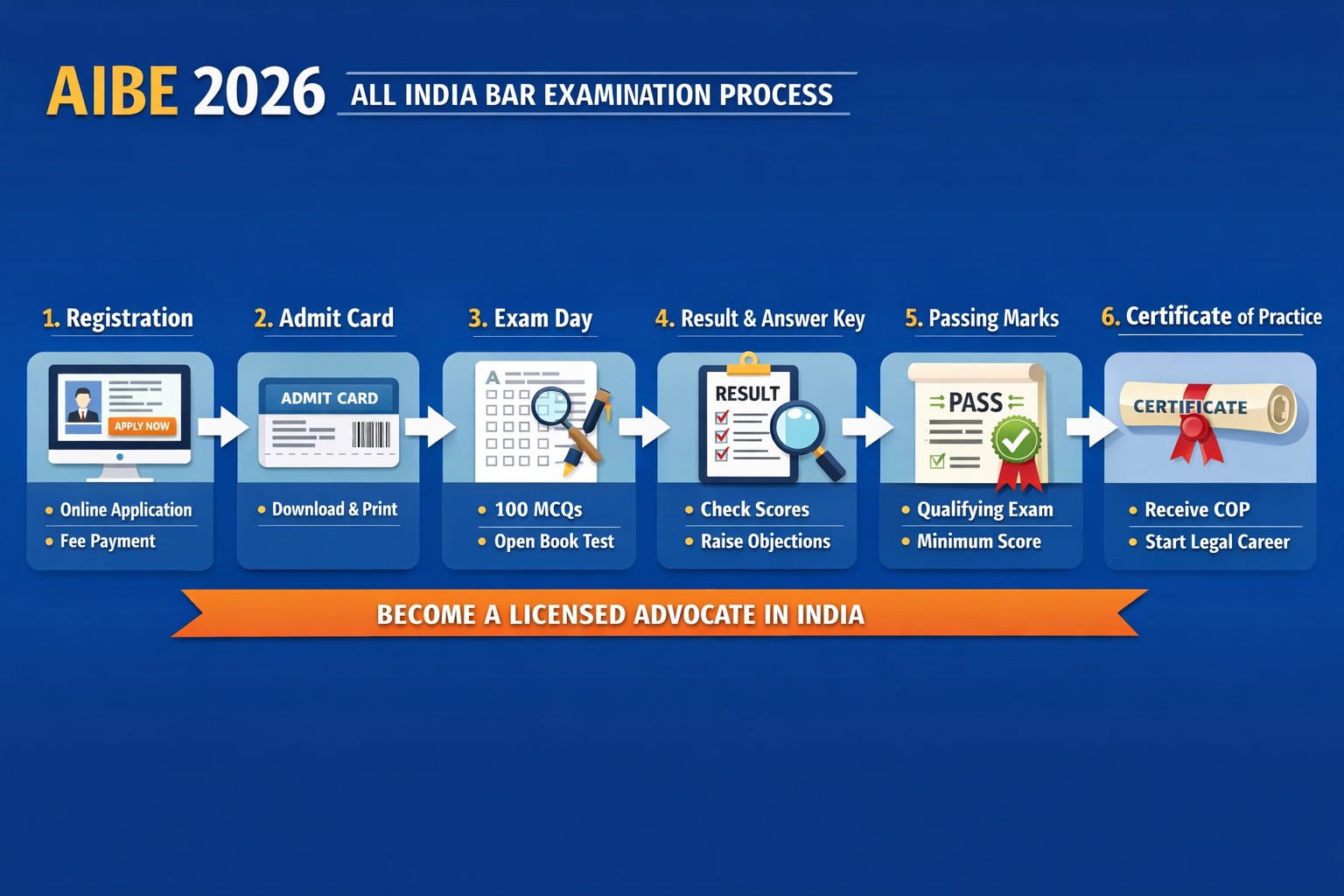
The registration process is online and conducted through the official AIBE portal.
Step-by-Step Process
-
Visit the official AIBE website Click
-
Complete online registration
-
Upload required documents
-
Pay the application fee
-
Download confirmation slip
Documents Required
- LLB degree or provisional certificate
- State Bar Council enrollment certificate
- Photograph & signature
- ID proof
AIBE 2026 Application Fee
| Category | Fee (Approx.) |
|---|---|
| General / OBC | Rs 3,500 |
| SC / ST | Rs 2,500 |
(Fee may change as per BCI notification.)
AIBE 2026 Passing Criteria
- AIBE is a qualifying exam
- Candidates need to score minimum passing marks
- No merit list or ranking is published
After Clearing AIBE
- Candidates receive a Certificate of Practice (COP)
- Eligible to practice law in all Indian courts
How to Prepare for AIBE 2026?
AIBE preparation is different from competitive exams like CLAT or judiciary exams.
Smart Preparation Tips
- Focus on core subjects, not optional ones
- Revise Bare Acts thoroughly
- Understand key sections and landmark judgments
- Practice previous year question papers
- Learn Professional Ethics & Bar Council Rules properly
What NOT to Do
- Don’t rely fully on open-book advantage
- Don’t ignore procedural laws (CPC, CrPC)
- Don’t skip revision thinking the exam is “easy.”
Common Mistakes Students Make in AIBE
- Carrying too many books to the exam hall
- Spending too much time searching answers
- Ignoring time management
- Underestimating Professional Ethics section
Career Impact of Clearing AIBE
Clearing AIBE 2026 opens multiple legal career paths:
- Court practice as an Advocate
- Litigation in District Courts, High Courts, Supreme Court
- Legal advisor in corporations and firms
- Government legal roles (after relevant exams)
- Independent law practice
Without AIBE clearance, legal practice is restricted, making it a crucial step for every law graduate.
Why Puran Murti College of Law Is a Good Choice for Law Students
(LLB & Integrated Law Courses)
Puran Murti College of Law has emerged as a reliable and student-focused destination for aspiring lawyers who want to build a strong foundation in legal education. For students planning to join LLB (3-Year) or 5-Year Integrated Law courses (BA LLB / BBA LLB), the institution offers a structured academic framework that strictly follows Bar Council of India (BCI) norms. The curriculum is designed to balance theoretical understanding and practical legal training, helping students grasp core subjects like Constitutional Law, Criminal Law, Civil Law, and Professional Ethics from the very beginning. Apply Now
One of the key strengths of Puran Murti for law students is its practice-oriented learning approach. Regular moot court sessions, mock trials, legal drafting exercises, case law analysis, and seminars ensure that students do not remain limited to textbooks alone. This practical exposure plays a crucial role in preparing students for courtroom practice, internships, and qualifying exams like the AIBE (All India Bar Examination). The institution also encourages participation in debates, legal aid activities, and workshops, which helps students develop advocacy, communication, and analytical skills—essential qualities for a successful legal career.
Additionally, Puran Murti College of Law focuses on the overall professional development of law students. With guidance from experienced faculty, career counseling support, and emphasis on ethics and discipline, students are prepared for multiple career paths after LLB, including litigation, corporate law, judiciary preparation, legal consultancy, and higher studies (LLM). For students looking for an institution that combines affordable education, academic discipline, and career-focused legal training, Puran Murti stands as a strong and practical choice to begin their journey in the field of law. Apply Now

Conclusion
The AIBE 2026 is not just an exam—it is the gateway to becoming a practicing advocate in India. While it is qualifying in nature, proper preparation, clear concepts, and understanding of core law subjects are essential to clear it in the first attempt.
For law graduates serious about litigation and professional legal practice, AIBE is a milestone that cannot be ignored.
Frequently Asked Questions (FAQs)
Is AIBE compulsory?
Yes, AIBE is compulsory to obtain the Certificate of Practice.
Is AIBE difficult?
No, it tests basic law knowledge, but preparation is still necessary.
How many attempts are allowed?
There is no limit on attempts.
Is AIBE open book?
Yes, Bare Acts are allowed, but smart usage is important.