
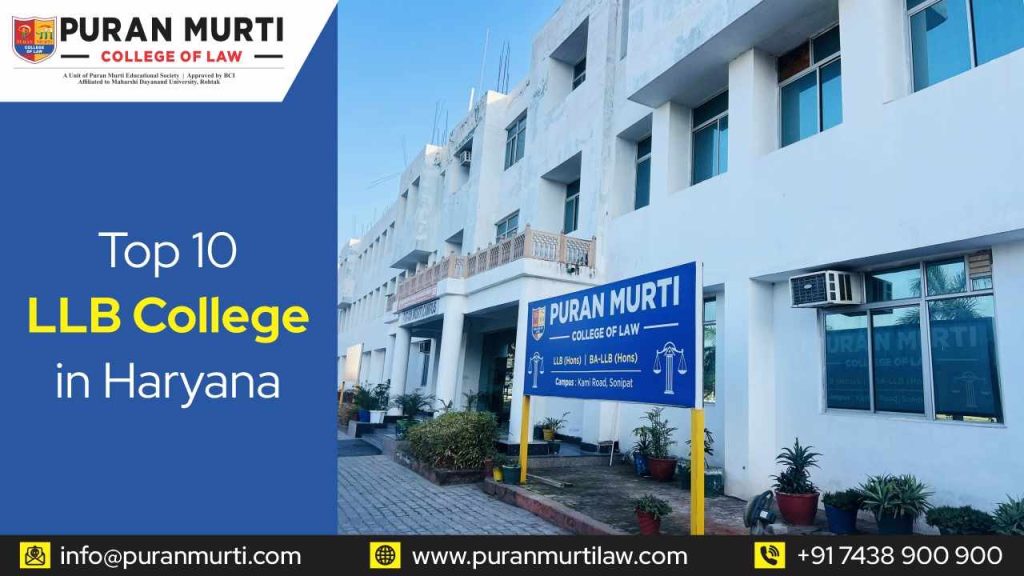
Top 10 LLB Colleges in Haryana: Courses & Career
Posted on : 26 September, 2026 10:38 pm
Choosing the right law college is an important decision because an LLB degree is only the beginning of a legal career. The quality of legal education, practical training, internships, moot-court exposure, faculty support, location and professional opportunities can all influence a student’s learning experience.
For students searching for the top 10 LLB colleges in Haryana, the state offers several options across Sonipat, Gurugram, Rohtak, Faridabad, Kurukshetra and other education hubs.
Haryana is particularly attractive for students from Delhi NCR because several law institutions are within convenient reach of the capital and its wider legal ecosystem.
This guide explains the leading options, what students should compare before admission, how a 3-year LLB works, and what career opportunities can follow after graduation.
What Is a 3-Year LLB Course?
A 3-year LLB is a professional law degree generally pursued after completing a bachelor’s degree. Unlike a five-year integrated BA LLB or BBA LLB, the three-year route allows graduates from another discipline to enter legal education.
For example, a student with a bachelor’s degree in engineering, management, commerce, arts or another eligible discipline may explore a 3-year LLB, subject to the admission rules of the institution.
MDU’s current law information, for example, lists its LLB (Hons.) as a three-year programme for graduates.
3-Year LLB vs 5-Year Integrated Law: Which One Is For You?
| Feature | 3-Year LLB | 5-Year Integrated LLB |
|---|---|---|
| Entry point | After graduation | After Class 12 |
| Duration | 3 years | 5 years |
| Common formats | LLB / LLB (Hons.) | BA LLB, BBA LLB, B.Com LLB |
| Suitable for | Graduates changing or adding a legal qualification | Students choosing law after school |
| Academic focus | Legal education after an existing degree | Undergraduate + legal education |
| Career direction | Legal profession, corporate roles, judiciary preparation, research | Similar legal career pathways |
Which LLB route should students choose?
Students should choose based on their current educational stage. If you have already completed graduation, the three-year LLB can be the relevant pathway. If you have completed Class 12 and want to pursue law directly, an integrated five-year programme may be more appropriate.
Top 10 LLB Colleges in Haryana and Nearby Delhi NCR
| Rank | College / University | Location | Type | Key Law Pathway |
|---|---|---|---|---|
| 1 | National Law University Delhi | Dwarka, Delhi | National Law University | B.A. LL.B. (Hons.) |
| 2 | Guru Gobind Singh Indraprastha University | Delhi | State University | LL.B., B.A. LL.B., BBA LL.B. and other law programmes |
| 3 | Puran Murti College of Law | Sonipat | Private | LLB (Hons.), BA LLB (Hons.), LLM |
| 4 | Dr. B.R. Ambedkar National Law University | Rai, Sonipat | National Law University | B.A. LL.B. (Hons.), B.B.A. LL.B. (Hons.) |
| 5 | O.P. Jindal Global University – Jindal Global Law School | Sonipat | Private University | LL.B. (Hons.), B.A. LL.B., BBA LL.B., B.Com LL.B. |
| 6 | Maharshi Dayanand University | Rohtak | State University | 3-Year LL.B. (Hons.), B.A. LL.B. |
| 7 | Kurukshetra University | Kurukshetra | State University | LL.B., integrated law programmes |
| 8 | Amity University Haryana | Gurugram | Private University | Law programmes |
| 9 | Manav Rachna University | Faridabad | Private University | Law programmes |
| 10 | SGT University | Gurugram | Private University | Law programmes |
Government and Private LLB Colleges in Haryana: What Is the Difference?
One of the most common questions students ask is whether they should choose a government university or a private law college.
There is no universal answer. The right choice depends on the student’s academic goals, budget, preferred location and career plans.
| Factor | Government/State University | Private University/College |
|---|---|---|
| Fees | Often comparatively lower, depending on programme | Can be higher |
| Admission | Merit/entrance rules vary | Institution-specific rules |
| Campus | University-based in many cases | Often extensive campus infrastructure |
| Course options | Varies | Often multiple programme formats |
| Practical exposure | Depends on institution | Depends on institution |
| Location | Varies | Strong NCR options available |
| Career support | Institution-specific | Institution-specific |
| Best approach | Compare programme-specific details | Compare programme-specific details |
The most important point is simple: do not choose a law college only because it is government or private. Compare the actual law programme.
3-Year LLB vs 5-Year Integrated LLB
Students often confuse these two routes.
3-Year LLB
The three-year LLB is generally designed for students who have already completed a bachelor’s degree.
For example:
B.Com → 3-Year LLB
BBA → 3-Year LLB
B.Tech → 3-Year LLB
BA → 3-Year LLB
B.Sc → 3-Year LLB
Eligibility is institution-specific.
5-Year Integrated LLB
The five-year integrated route is generally pursued after Class 12.
Examples include:
- BA LLB
- BBA LLB
- B.Com LLB
For example:
Class 12 → BA LLB → Legal Career
This route combines undergraduate study with legal education.
How to Choose the Best LLB College in Haryana
Before applying, compare these factors carefully.
1. Check Recognition and Affiliation
Always verify the current status of the specific law programme.
Check:
- Bar Council of India recognition/approval where applicable
- University status
- Affiliation
- Current admission notification
- Programme-specific eligibility
Never depend solely on an old blog or education-directory listing.
2. Compare the Curriculum
A good law curriculum should expose students to important areas such as:
- Constitutional Law
- Contract Law
- Criminal Law
- Family Law
- Property Law
- Jurisprudence
- Civil Procedure
- Criminal Procedure
- Evidence
- Corporate Law
- Intellectual Property Rights
- Cyber Law
- Labour Law
3. Look Beyond Classroom Learning
Legal education becomes more meaningful when students can apply concepts.
Look for:
- Moot courts
- Mock trials
- Legal aid
- Client counselling
- Internships
- Legal drafting
- Research projects
- Debates
- Negotiation competitions
- Seminars
- Guest lectures
4. Check the Law Library
A serious law student needs access to quality research resources.
During a campus visit, ask about:
- Physical law books
- Legal databases
- Online journals
- Case-law resources
- Research facilities
- Computer access
5. Investigate Career Support
Don’t ask only:
“What is the highest package?”
Instead ask:
- Which organisations recruit law students?
- Are placement figures law-specific?
- What internships do students receive?
- Does the college facilitate internships?
- Are alumni working in law firms?
- What career counselling is provided?
- Are judiciary and competitive-exam aspirants supported?
Career Opportunities After LLB
An LLB can open pathways across legal practice, business, government and research.
Common Career Options
- Advocate
- Corporate Lawyer
- Legal Advisor
- Legal Executive
- Compliance Professional
- Legal Researcher
- Law Officer
- Legal Consultant
- Judiciary Aspirant
- Academic or Research Professional
Career outcomes depend on an individual’s skills, professional qualifications, internships, networking, examination performance and chosen specialization.
Can Engineering and Management Graduates Pursue LLB?
Yes, graduates from non-law backgrounds can explore the 3-year LLB route, subject to the eligibility requirements of the institution they apply to.
This can be particularly relevant for engineering and management graduates interested in areas such as:
- Cyber law
- Intellectual property
- Technology law
- Corporate law
- Contract management
- Compliance
- Data protection
- Business law
Can Engineering Students Pursue LLB?
Yes. Engineering graduates can explore the three-year LLB route if they satisfy the eligibility requirements of the institution.
This can be particularly interesting for students who want to combine technical knowledge with legal education.
Possible areas include:
- Cyber law
- Intellectual property
- Technology regulation
- Data protection
- Corporate compliance
- Technology contracts
However, students should understand that an LLB is a professional change or addition to their existing academic background, and career outcomes depend on skills, internships and professional development.

Can Management Students Pursue LLB?
Yes. Graduates from management backgrounds can also explore three-year LLB programmes where eligible.
The combination can be useful for students interested in:
- Corporate law
- Contract management
- Compliance
- Business regulations
- Labour law
- Corporate governance
- Legal operations
Why Sonipat Is Becoming Important for Law Education
For students searching for law colleges in Sonipat, the city has a particularly relevant location within the NCR region.
Sonipat and Rai are home to multiple higher-education institutions, including:
- Dr. B.R. Ambedkar National Law University
- O.P. Jindal Global University
- Puran Murti Vidyapeeth
- Other universities and colleges
This makes Sonipat an important location for students who want to study law in Haryana while remaining relatively close to Delhi NCR.
LLB Admission in Haryana: General Process
The admission process varies from institution to institution.
Generally, students should follow these steps:
Step 1: Select the LLB Route
Choose between:
- 3-year LLB after graduation
- 5-year integrated LLB after Class 12
Step 2: Check Eligibility
Read the current official eligibility criteria.
Step 3: Check Entrance Requirements
Some universities use entrance examinations, while others may have different admission procedures.
Step 4: Complete the Application
Submit the online application and required documents.
Step 5: Attend Counselling/Admission Process
Complete counselling, merit or entrance-based admission requirements where applicable.
Step 6: Verify Documents
Common documents can include:
- Class 10 certificate
- Class 12 certificate
- Graduation marksheets for 3-year LLB
- Degree/provisional certificate
- Identity proof
- Photographs
- Category certificate where applicable
- Migration/transfer certificate where required
Frequently Asked Questions
What are the top 10 LLB colleges in Haryana?
The 2026 shortlist includes Amity University Haryana, Puran Murti College of Law, O.P. Jindal Global University, Maharshi Dayanand University, Kurukshetra University, Manav Rachna University, SRM University Delhi-NCR, K.R. Mangalam University, SGT University and Geeta University. The list is a practical shortlist rather than an official government ranking.
Which is the best LLB college in Sonipat?
Students should compare Sonipat law colleges based on BCI approval, affiliation, curriculum, faculty, fees, moot courts, internships, legal research facilities and career support. Puran Murti College of Law and other Sonipat institutions can be researched according to these criteria.
Is LLB a 3-year or 5-year course?
Both routes are available. A 3-year LLB is generally pursued after graduation, while integrated programmes such as BA LLB are generally five years after Class 12. Eligibility and admission rules vary by institution.
Can I pursue LLB after engineering?
Yes. Engineering graduates can generally explore the three-year LLB route if they satisfy the eligibility requirements of the university or college. A law degree can complement technical backgrounds in areas such as technology law, intellectual property and compliance.
Can I pursue LLB after an MBA?
Yes. MBA graduates can explore a three-year LLB, subject to the admission requirements of the institution. The combination may be relevant for careers involving corporate law, contracts, compliance, business regulation and legal management.
What should I check before choosing an LLB college?
Check BCI approval or recognition, university affiliation, course structure, faculty, practical training, moot courts, internships, law-library resources, fees, location, career support and verified placement information.
Conclusion
Finding the right college from the top 10 LLB colleges in Haryana depends on much more than a ranking number. Students should examine recognition, curriculum, practical legal training, internships, faculty, location, fees and career support before choosing an institution.
For students specifically searching for LLB colleges in Sonipat and Delhi NCR, Puran Murti College of Law is one institution they can explore. Its official information lists LLB (Hons.), BA LLB (Hons.) and LLM programmes, along with BCI approval and MDU affiliation information.
If you are planning to pursue law after graduation or considering an integrated law programme after Class 12, take the next step by comparing your preferred course, eligibility, fees and career goals.
Interested in studying law at Puran Murti Vidyapeeth? Contact the admissions team, request current course details and plan a campus visit to understand the academic environment before making your decision.