

Understanding the Indian Constitution
Posted on : 30 December, 2025 1:11 am
The Indian Constitution is the foundation of India’s legal, political, and democratic system. For law aspirants and students, especially those pursuing or planning to pursue law, understanding the Indian Constitution is the first and most important step in any BA LLB complete guide. It is not just a subject to pass exams, but a living document that governs every aspect of Indian society, administration, and justice.
In a BA LLB complete guide, Constitutional Law is treated as the backbone of legal education because it influences criminal law, civil law, corporate law, administrative law, and even international law. This article offers a detailed, structured, and student-friendly explanation of the Indian Constitution, designed specifically for BA LLB students, CLAT aspirants, judiciary candidates, and anyone seeking a strong conceptual foundation.
Get in Touch with PMCL Law Experts
📞 Call: +7438900900
📧 Email: info@puranmurti.in
🌐 Visit: Puran Murti College of Law Official Website
What Is the Indian Constitution? – BA LLB Complete Guide
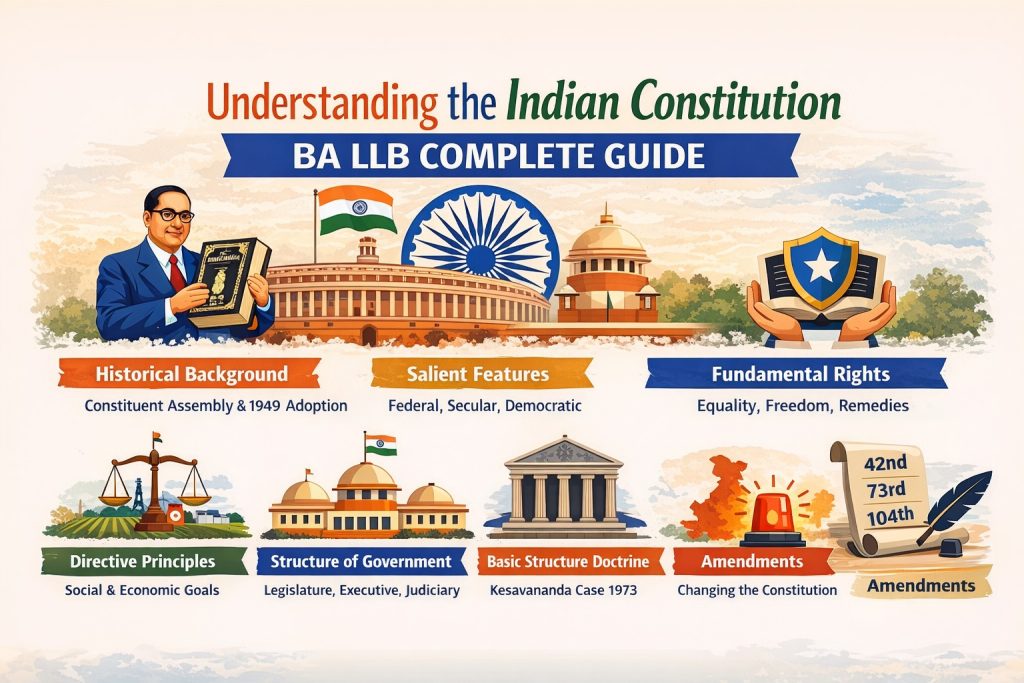
The Indian Constitution is the supreme law of India. It defines the structure of government, distributes powers, protects citizens’ rights, and establishes the rule of law. Every BA LLB complete guide begins with the Constitution because all other laws derive their authority from it.
Adopted on 26 November 1949 and enforced on 26 January 1950, the Constitution ensures that India functions as a sovereign, democratic republic governed by constitutional principles rather than arbitrary power.
For BA LLB students, understanding the Constitution is essential for:
-
Academic success
-
Competitive exams
-
Legal practice
-
Judicial services
-
Policy and governance roles
Importance of the Indian Constitution in a BA LLB Complete Guide
In any BA LLB complete guide, the Indian Constitution is considered the most important subject because:
-
It introduces students to legal reasoning
-
It explains state power vs individual liberty
-
It lays the foundation for judicial interpretation
-
It helps understand landmark judgments
-
It connects law with society and ethics
Without a strong command over constitutional law, a BA LLB student cannot fully understand Indian legal systems.
Historical Background of the Indian Constitution
Pre-Independence Developments
Every BA LLB complete guide emphasizes the historical evolution of the Constitution. Important milestones include:
-
Regulating Act, 1773
-
Pitt’s India Act, 1784
-
Charter Acts (1833 & 1853)
-
Indian Councils Acts
-
Government of India Act, 1919
-
Government of India Act, 1935
The Government of India Act, 1935 heavily influenced the federal structure of the Indian Constitution.
Constituent Assembly and Drafting Process
The Constituent Assembly was formed in 1946. Dr. B. R. Ambedkar, known as the Architect of the Indian Constitution, played a pivotal role as Chairman of the Drafting Committee.
Key facts every BA LLB complete guide highlights:
-
Drafting took 2 years, 11 months, and 18 days
-
11 sessions were held
-
The Constitution was handwritten and illustrated
-
Extensive debates shaped its democratic nature
Sources of the Indian Constitution – BA LLB Complete Guide
The Indian Constitution borrows the best principles from various countries, a topic commonly asked in exams and emphasized in every BA LLB complete guide.
| Country | Borrowed Features |
|---|---|
| UK | Parliamentary system, Rule of Law |
| USA | Fundamental Rights, Judicial Review |
| Ireland | Directive Principles |
| Canada | Federation with strong Centre |
| Australia | Concurrent List |
| France | Liberty, Equality, Fraternity |
Salient Features of the Indian Constitution
1. Longest Written Constitution
The Indian Constitution contains:
-
470 Articles
-
25 Parts
-
12 Schedules
Its detailed nature makes it a major study area in any BA LLB complete guide.
2. Federal Structure with Unitary Bias
India follows a quasi-federal system where powers are divided between the Union and States, but the Centre holds stronger authority during emergencies.
3. Parliamentary Form of Government
The executive is accountable to the legislature, reinforcing democratic responsibility—an important constitutional concept in a BA LLB complete guide.
4. Supremacy of the Constitution
All laws, authorities, and institutions derive power from the Constitution. Any law violating constitutional provisions can be struck down.
5. Independent Judiciary
Judicial independence ensures:
-
Fair interpretation of laws
-
Protection of rights
-
Balance of power
This is a core pillar discussed in every BA LLB complete guide.
The Preamble of the Indian Constitution – BA LLB Complete Guide
The Preamble is the philosophical introduction to the Constitution and reflects its spirit.
It declares India as:
-
Sovereign
-
Socialist
-
Secular
-
Democratic
-
Republic
And secures:
-
Justice
-
Liberty
-
Equality
-
Fraternity
In a BA LLB complete guide, the Preamble is often referred to as the “identity card” of the Constitution.
Fundamental Rights (Articles 12–35)
Fundamental Rights are the heart of the Constitution and a major focus area in every BA LLB complete guide.
1. Right to Equality (Articles 14–18)
-
Equality before law
-
Prohibition of discrimination
-
Abolition of untouchability
-
Abolition of titles
2. Right to Freedom (Articles 19–22)
Includes freedoms of:
-
Speech and expression
-
Assembly
-
Movement
-
Profession
3. Right Against Exploitation
-
Prohibits human trafficking
-
Bans child labor in hazardous work
4. Right to Freedom of Religion
Ensures religious liberty and secularism.
5. Cultural and Educational Rights
Protects minority interests.
6. Right to Constitutional Remedies
Allows citizens to approach courts directly—called the “heart and soul” of the Constitution by Dr. Ambedkar.
Directive Principles of State Policy
Articles 36–51 guide the State in governance. Though non-justiciable, they are fundamental in policymaking.
Key principles include:
-
Social justice
-
Equal pay
-
Free legal aid
-
Environmental protection
In a BA LLB complete guide, DPSPs are studied alongside Fundamental Rights to understand constitutional balance.
Fundamental Duties
Added by the 42nd Amendment (1976), Fundamental Duties remind citizens of their responsibilities, such as:
-
Respecting the Constitution
-
Promoting harmony
-
Protecting the environment
Structure of Indian Government – BA LLB Complete Guide
Legislature
-
Parliament
-
State Legislatures
Executive
-
President
-
Prime Minister
-
Council of Ministers
Judiciary
-
Supreme Court
-
High Courts
-
Subordinate Courts
This separation of powers is essential to constitutional governance and widely covered in any BA LLB complete guide.
Emergency Provisions – BA LLB Complete Guide
The Constitution provides for:
-
National Emergency
-
State Emergency
-
Financial Emergency
These provisions show the flexibility of the Constitution and are frequently tested in law exams.
Constitutional Amendments – BA LLB Complete Guide
The Constitution is neither rigid nor flexible—it is balanced.
Types of amendments:
-
Simple majority
-
Special majority
-
Special majority + state ratification
Landmark amendments include:
-
42nd Amendment
-
44th Amendment
-
73rd & 74th Amendments
Landmark Constitutional Judgments – BA LLB Complete Guide
Important cases every BA LLB student must know:
-
Kesavananda Bharati – Basic Structure Doctrine
-
Maneka Gandhi – Expanded Article 21
-
Minerva Mills
-
Indra Sawhney
-
Navtej Singh Johar
These judgments demonstrate the living nature of the Constitution.
Relevance of the Indian Constitution in Legal Practice – BA LLB Complete Guide
The Constitution is applied daily in:
-
Litigation
-
PILs
-
Corporate compliance
-
Human rights advocacy
-
Government policy drafting
A strong constitutional foundation enhances every legal career.
Why Understanding the Indian Constitution Is Crucial for BA LLB Students
In a BA LLB complete guide, constitutional understanding helps students:
-
Crack judiciary exams
-
Clear CLAT PG
-
Succeed in litigation
-
Understand policy-making
-
Build ethical legal reasoning
Interpretation of the Indian Constitution
One of the most important skills developed through constitutional law in a BA LLB complete guide is the ability to interpret the Constitution. Since the Constitution is a living document, courts must interpret its provisions in light of changing social, economic, and political conditions.
Major Principles of Constitutional Interpretation
-
Literal Rule – Words are given their plain meaning
-
Harmonious Construction – Conflicting provisions are interpreted to maintain balance
-
Doctrine of Pith and Substance – Focuses on the true nature of legislation
-
Doctrine of Colourable Legislation – Prevents misuse of legislative power
-
Purposive Interpretation – Considers the intent behind provisions
These doctrines are frequently discussed in constitutional law papers and are an essential part of any BA LLB complete guide.
Doctrine of Basic Structure – BA LLB Complete Guide
The Basic Structure Doctrine is one of the most significant contributions of Indian constitutional jurisprudence.
Origin of the Doctrine
The doctrine was established in the landmark case of Kesavananda Bharati v. State of Kerala (1973). The Supreme Court held that while Parliament has the power to amend the Constitution, it cannot alter its basic structure.
Elements of Basic Structure
Although not exhaustively defined, key elements include:
-
Supremacy of the Constitution
-
Rule of Law
-
Separation of Powers
-
Judicial Review
-
Federalism
-
Secularism
Every BA LLB complete guide treats this doctrine as a cornerstone of constitutional law.
Judicial Review in India: BA LLB Complete Guide
Judicial Review is the power of courts to examine the constitutionality of legislative and executive actions.
Importance of Judicial Review
-
Protects Fundamental Rights
-
Maintains constitutional supremacy
-
Prevents misuse of power
Articles 13, 32, and 226 form the constitutional basis of judicial review. In a BA LLB complete guide, judicial review is considered essential to understanding the role of the judiciary.
Public Interest Litigation (PIL)
Public Interest Litigation has expanded access to justice and is a unique feature of Indian constitutional law.
Key Features of PIL
-
Relaxed locus standi
-
Protection of collective rights
-
Judicial activism
Impact of PIL
PILs have addressed issues related to:
-
Environmental protection
-
Human rights
-
Prison reforms
-
Women and child welfare
In every BA LLB complete guide, PIL is highlighted as an example of constitutional law in action.
Federalism in the Indian Constitution – BA LLB Complete Guide
India follows a federal system, but with a strong central authority.
Distribution of Powers
-
Union List
-
State List
-
Concurrent List
The presence of emergency provisions and the role of the Governor give India a unitary tilt, which is critically analyzed in a BA LLB complete guide.
Role of the President Under the Indian Constitution
The President is the constitutional head of India.
Powers of the President
-
Executive powers
-
Legislative powers
-
Judicial powers
-
Emergency powers
Although the President acts on the advice of the Council of Ministers, understanding these powers is essential in a BA LLB complete guide.
Role of the Prime Minister and Council of Ministers
The real executive authority lies with the Prime Minister and Council of Ministers.
Key Functions
-
Policy formulation
-
Administration
-
Law-making
-
Crisis management
This balance between nominal and real executive authority is an important constitutional concept in a BA LLB complete guide.
Constitutional Status of Local Self-Government
The 73rd and 74th Constitutional Amendments strengthened grassroots democracy.
Panchayati Raj Institutions
-
Gram Panchayat
-
Panchayat Samiti
-
Zila Parishad
Urban Local Bodies
-
Municipal Corporations
-
Municipal Councils
Decentralization of power is an important modern development covered in every BA LLB complete guide.
Reservation Policy and Equality – BA LLB Complete Guide
Reservation is a key constitutional mechanism to achieve social justice.
Constitutional Provisions
-
Articles 15(4), 15(5), 16(4)
-
Reservations for SCs, STs, OBCs, and EWS
Landmark judgments such as Indra Sawhney v. Union of India are essential reading in a BA LLB complete guide.
Secularism Under the Indian Constitution
India follows positive secularism, meaning equal respect for all religions.
Constitutional Safeguards
-
Articles 25–28
-
Freedom of conscience
-
Non-discrimination
Secularism is also part of the Basic Structure, making it a recurring topic in any BA LLB complete guide.
Citizenship Under the Indian Constitution
Articles 5–11 deal with citizenship.
Types of Citizenship
-
By birth
-
By descent
-
By registration
-
By naturalization
Citizenship laws are frequently debated and form an important part of constitutional studies in a BA LLB complete guide.
Language Provisions in the Indian Constitution
The Constitution recognizes linguistic diversity.
Key Provisions
-
Hindi and English as official languages
-
Eighth Schedule languages
-
Protection of linguistic minorities
Language provisions highlight India’s pluralistic nature and are covered in constitutional law syllabi in a BA LLB complete guide.
Comparison with Other Constitutions
Comparative constitutional analysis helps students understand India’s uniqueness.
Indian Constitution vs US Constitution
-
Written vs brief
-
Parliamentary vs presidential system
-
Flexible vs rigid amendments
This analytical approach is encouraged in advanced constitutional law studies within a BA LLB complete guide.
Contemporary Constitutional Challenges
Modern constitutional issues include:
-
Digital privacy
-
Freedom of speech online
-
National security vs liberty
-
Judicial overreach
-
Federal disputes
These evolving challenges make constitutional law dynamic and relevant, as emphasized in every BA LLB complete guide.
How to Study the Indian Constitution Effectively
Tips for BA LLB Students
-
Read bare acts regularly
-
Link articles with cases
-
Make flowcharts and tables
-
Revise landmark judgments
-
Follow constitutional debates
These strategies are recommended in every successful BA LLB complete guide.
Exams for BA LLB in India
Admission to the BA LLB (5-year integrated law course) in India is primarily through national-level, state-level, and university-level law entrance exams. These exams test a student’s aptitude for legal studies, logical reasoning, and general awareness.
Below is a complete and updated list of major BA LLB entrance exams.
National-Level BA LLB Entrance Exams
1️⃣ CLAT (Common Law Admission Test)
Conducted by: Consortium of NLUs
Course Offered: BA LLB (Hons)
Accepted By: 22+ National Law Universities (NLUs)
Subjects Tested:
-
English Language
-
Current Affairs & GK
-
Legal Reasoning
-
Logical Reasoning
-
Quantitative Techniques
📌 CLAT is the most popular and competitive exam for BA LLB aspirants in India.
2️⃣ AILET (All India Law Entrance Test)
Conducted by: National Law University, Delhi
Course Offered: BA LLB (Hons)
Accepted By: NLU Delhi only
Subjects Tested:
-
English
-
Current Affairs & GK
-
Logical Reasoning
📌 AILET is known for its high difficulty level and limited seats.
University-Level BA LLB Entrance Exams
3️⃣ LSAT–India
Conducted by: LSAC (India)
Course Offered: BA LLB
Accepted By: Private universities & law colleges
Subjects Tested:
-
Logical Reasoning
-
Analytical Reasoning
-
Reading Comprehension
📌 LSAT focuses on reasoning ability rather than GK.
4️⃣ CUET–UG (for Law Programs)
Conducted by: NTA
Course Offered: BA LLB (at select universities)
Subjects Tested:
-
Language test
-
Domain subjects
-
General test
📌 CUET is gaining importance for central universities.
5️⃣ DU BA LLB Entrance (via CUET / University Process)
Conducted by: University of Delhi
Course Offered: BA LLB
Accepted By: Faculty of Law, DU
State-Level BA LLB Entrance Exams
6️⃣ MH CET Law
Conducted by: Maharashtra State CET Cell
Course Offered: BA LLB (5 years)
Accepted By: Law colleges in Maharashtra
7️⃣ AP LAWCET
Conducted by: Andhra Pradesh State Council
Course Offered: BA LLB
8️⃣ TS LAWCET
Conducted by: Telangana State Council
Course Offered: BA LLB
9️⃣ KLEE (Kerala Law Entrance Exam)
Conducted by: Commissioner for Entrance Exams, Kerala
Course Offered: BA LLB
Exam Pattern for BA LLB Entrance Exams
| Section | Focus Area |
|---|---|
| English | Reading & grammar |
| Legal Reasoning | Legal aptitude |
| Logical Reasoning | Analytical skills |
| GK & Current Affairs | Awareness |
| Quantitative Aptitude | Basic maths |
Direct Admission & Merit-Based Entry at PMCL
Unlike many universities, Puran Murti College of Law (PMCL) also offers merit-based BA LLB admissions, subject to eligibility criteria prescribed by affiliating bodies and regulatory authorities.
Eligibility for BA LLB at PMCL:
-
10+2 from a recognized board
-
Minimum marks:
-
General: 45%
-
OBC: 42%
-
SC/ST: 40%
-
-
No age limit
📌 Students who have appeared for CLAT, AILET, CUET, or other law entrance exams are given academic guidance to transition smoothly into BA LLB at PMCL.
Why Choose PMCL After BA LLB Entrance Exams?
Students who join Puran Murti College of Law after preparing for BA LLB entrance exams benefit from:
-
Strong constitutional law foundation
-
Practical training (moot courts, internships)
-
Judiciary and litigation-focused guidance
-
Career counseling & placement support
-
Affordable quality legal education
Career Opportunities Linked to Constitutional Law
Strong knowledge of constitutional law opens doors to:
-
Litigation
-
Judiciary
-
Civil services
-
Academia
-
Policy research
-
Human rights advocacy
Thus, constitutional law is not just academic but career-defining, as highlighted in a BA LLB complete guide.
Final Conclusion – BA LLB Complete Guide to Understanding the Indian Constitution
The Indian Constitution is a living, evolving document that shapes India’s democracy and legal system. For law students, a deep understanding of constitutional principles is essential for academic excellence, professional growth, and ethical legal practice.
This BA LLB complete guide to understanding the Indian Constitution now provides extensive coverage, conceptual clarity, exam-oriented depth, and practical relevance—making it ideal for BA LLB students, CLAT aspirants, and judiciary candidates.